Quick answer
In field hockey a goal only counts if an attacker touches the ball inside the shooting circle, so every shot starts with getting the ball into the circle. Once there, you choose a shot by time and space: the hit or slap hit for power from the top of the circle, the push or flick for a quick release close in, the deflection when a teammate passes across goal, and the reverse stick shot when the ball is on your left side. Good shooters aim for the corners, shoot early and follow every shot in for the rebound.
Key takeaways
- The ball must be touched by an attacker inside the circle for a goal to count.
- Choose the shot by time and space, not by habit. Close in, a fast release beats a big swing.
- Aim low and to the corners, especially the far post, where goalkeepers find it hardest to reach.
- Raised shots in open play are allowed as long as they are not dangerous. Penalty corner shots have extra height rules; check your league's rules.
- Always follow your shot. Many goals come from rebounds.
The shot types
| Shot | Best position | Strength | Weakness |
|---|---|---|---|
| Hit | Top of the circle, with time | Most power | Big backswing, easy to block or tackle |
| Slap hit / sweep | Edge of the circle, wide angles | Power with a lower, quicker swing | Still needs some space |
| Push | Close to goal, under pressure | Fast release, accurate | Less pace |
| Flick | Close to goal, keeper on the ground | Lifts the ball over a keeper | Takes practice to keep safe and on target |
| Deflection | Near the posts | Changes direction late, very hard to save | Needs a good pass and timing |
| Reverse stick shot | Left side of the circle | Quick, surprises the keeper | Harder to control, needs practice |
| Tomahawk | Left side, ball close to the feet | Shoots from awkward positions | Advanced; risk of lifting the ball dangerously |
| Drag flick | Penalty corners | Powerful and can be raised | Specialist skill; train with a coach |
How to choose the right shot
You have time at the top of the circle
Use the hit or slap hit. Keep your head over the ball and your follow-through low to keep the ball on the ground, which also makes it easier for a teammate to deflect.
A defender is close to you
Use the push or a quick reverse stick shot. A big backswing gives the defender time to block or tackle. A fast, low push into the corner is often better than a hard hit into the defender's legs.
You are close to goal and the keeper goes down
A short flick over the keeper can work. It must be controlled and not dangerous to other players.
A teammate is crossing the ball
Get to the near post or the far post with your stick down and ready. A deflection only needs a small change of angle.
Where to aim
- Low corners: keepers find it harder to reach low and wide than high and central.
- Far post: a shot across the keeper also creates a chance for a deflection or rebound.
- Through traffic: a shot through legs can be hard for the keeper to see, but watch out for dangerous play.
Shooting drills
On the pitch
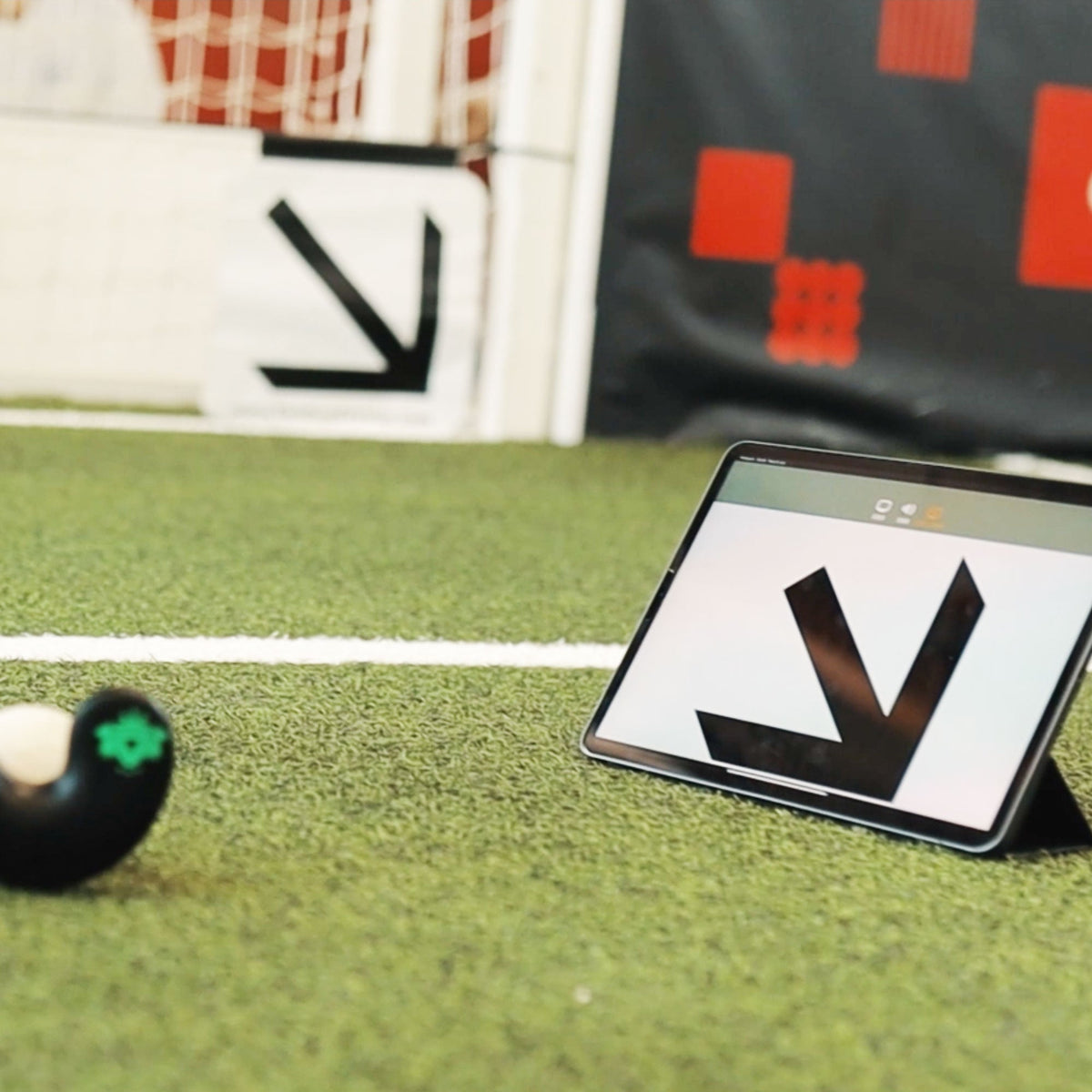
- Corner targets: attach a Goal Target (6 targets, each 42 × 42 cm / 16.5 × 16.5 in) or tie cones in the corners. Take 10 shots from the top of the circle and 10 from closer in. Count target hits.
- Receive and shoot: a feeder passes from the side. Receive, take one touch, shoot. 3 sets of 8, both sides.
- Deflection line: feeder slap hits across the circle; attacker deflects at the near post. 10 reps, then switch posts.
- Follow-in: after every shot, sprint to the post for 3 m (10 ft). Make it automatic.
Shoot only when the goal area is clear, and make sure the goalkeeper is fully kitted out before taking real shots at them.
At home (no shooting, but the set-up skills)
Indoors you shouldn't hit or lift the ball, but you can train what happens before the shot: the first touch, getting the ball out of your feet and a quick release.
- Receive and push: against a wall or Rebounder from 3–4 m (10–13 ft), receive and play a push to a taped corner square. 3 × 1 minute.
- Reverse release: receive on your forehand, move the ball to the reverse side and push. 3 × 1 minute.
- Head-up finish: dribble for 5 seconds, then someone calls "left" or "right" and you push to that target.
Common shooting mistakes
- Shooting at the keeper: look up before you shoot and aim away from them.
- Too many touches: every extra touch in the circle gives defenders time. Shoot earlier.
- Lifting hits dangerously: keep the follow-through low. Raised shots that endanger players are penalised.
- Standing still after the shot: follow in. Rebounds are free goals.
FAQ
Do you have to be inside the circle to score?
Yes. The ball must be touched by an attacker inside the circle before it crosses the goal line. A shot from outside the circle that nobody touches inside does not count.
Can you lift the ball when shooting?
In open play, yes, as long as it is not dangerous. At penalty corners there are extra limits on the height of the first shot if it is a hit. Rules for younger age groups can differ, so check your league's rules.
What is the easiest shot for beginners?
The push. It is quick, accurate and easy to keep on the ground. Learn to push into the corners before working on hits.
How do I shoot harder?
Use your legs and weight transfer, strike the ball cleanly in front of your body and follow through low. Power comes from technique more than arm strength.
Can I practise shooting at home?
Outdoors in a safe space, yes. Indoors, practise the first touch and quick push release instead of hitting.
Related articles
- How to hit a field hockey ball harder
- Field hockey shooting accuracy drills with targets
- Deflections: how to score from a pass
In the US? The Rebounder, Skiller and Skills Zone are also available on Amazon.