Quick answer
A penalty corner has three jobs done in about two seconds: the injection, the stop and the shot. The injector pushes or slaps the ball from the backline inside the circle to the top of the circle. A stopper traps it dead, just outside or on the circle edge. Then the shooter hits, flicks or sweeps it at goal, or the team runs a set play. Every part depends on the one before it, so a fast, flat injection and a clean stop matter as much as a hard shot.
Key takeaways
- The ball must travel outside the circle before anyone can shoot. Most teams stop it just outside the top of the circle, then bring it back in.
- A good injection is flat, fast and accurate. A slow, bouncing injection gives defenders time to run out.
- The stopper's job is a dead ball in the same spot every time, on the shooter's preferred side.
- The first shot at goal, if it is a hit, must cross the goal line low. Check your league's rules for the exact height limit and for youth or school variations.
- The injection and the stop can be practised at home. Hard hits and drag flicks belong on the pitch, with a goalkeeper or empty goal and protective gear.
How a penalty corner works
The umpire awards a penalty corner mostly for defending fouls inside the circle, or for some deliberate fouls in the 23m area. The ball is placed on the backline inside the circle, a set distance from the goal post, on the side the attack chooses. A limited number of defenders, including the goalkeeper, start behind the backline. The rest wait beyond the centre line. Attackers wait outside the circle.
The exact details (distances, how many defenders, masks, time limits) are set by your competition. Under-age and school leagues sometimes change them, so check your league's rules before you build routines around them.
Part 1: the injection
The injector usually uses a push or a slap hit along the ground. What matters:
- Stance: feet behind the backline, wide and low, weight moving towards the target.
- Flat ball: keep the stick face behind the ball and stay low through the release, so the ball rolls instead of bouncing.
- Same line every time: the stopper should not have to move to reach it.
- Get in: after the injection, the injector moves into the circle as an extra attacker.
Injection drill (pitch or long hallway)
Mark a 1 m (3 ft) wide target zone with two cones about 10 m (33 ft) away. Push 3 × 10 injections, counting how many arrive flat and inside the zone. Rest 1 minute between sets. At home, shorten the distance to 4–5 m (13–16 ft) and use push passes only. A Rebounder sends the ball back so you don't need a partner to collect it.
Part 2: the stop
The stopper receives a fast ball and leaves it dead for the shooter. Two common methods:
- Forehand stop: stick angled slightly forward over the ball, low body, soft hands. The ball stops just in front of the stick.
- Reverse stick stop: used by some teams for drag flickers. Harder to learn, so start slowly.
Good stoppers kneel or crouch low so the stick is close to flat on the ground. That reduces the chance of the ball popping up over the stick.
Stop drill
| Set | Distance | Reps | Goal |
|---|---|---|---|
| 1 | 4 m (13 ft) from a wall or rebounder | 20 stops | Ball dead within 30 cm (1 ft) |
| 2 | 5 m (16 ft), harder pushes | 20 stops | Same spot every time |
| 3 | Partner injecting on the pitch, 10 m+ | 3 × 10 | Dead ball, stopper moves away quickly |
Part 3: the shot
Once the ball is stopped, the shooter has options:
- Hit: a straight shot. If the first shot is a hit, it has to cross the goal line low, which favours flat, hard shots at the corners.
- Drag flick: a slinging shot that can go higher, as long as it is not dangerous. It takes a lot of supervised practice to learn safely.
- Slap or sweep: often used to deflect into goal from a teammate on the post.
- Variations: a pass to a second shooter, a deflection, or a run-around play.
Shot accuracy drill (pitch only)
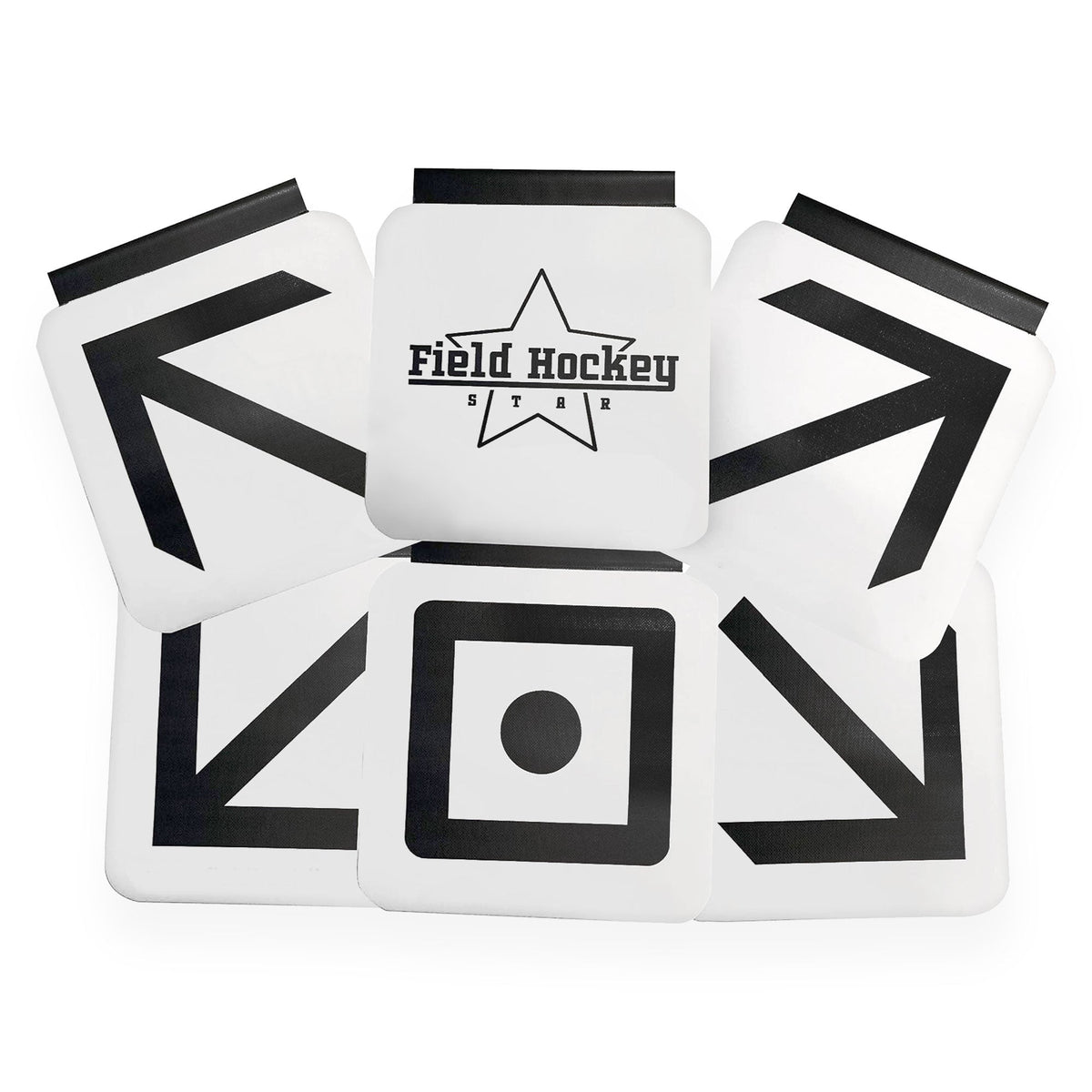
Hang targets in the corners of the goal. A Goal Target gives you six 42 × 42 cm targets that attach to the goal. Take 3 × 8 shots from the top of the circle after a stop, aiming for the low corners. Count hits on target. Wear proper protection and make sure nobody stands near the goal.
Practising at home safely
At home or indoors there is no hitting, no lifting and no drag flicks. You can still sharpen two of the three parts:
- Push injections to a target or rebounder, 3 × 10 reps.
- Stops from fast push passes off a wall or rebounder, 3 × 20 reps.
- Stop-and-move: stop the ball, then take one quick step to set up a pretend shot without striking.
A smooth floor or flooring tiles help the ball roll true. Honest note: a solid wall works too. Neither a wall nor a rebounder replaces a partner injecting at match speed, and nothing at home replaces drag flick coaching on the pitch.
FAQ
Why does the ball have to leave the circle at a penalty corner?
The rules require the ball to travel outside the circle before a shot is taken. That is why teams stop the ball at or just beyond the top of the circle and then shoot.
How high can the first shot be at a penalty corner?
If the first shot is a hit, it must cross the goal line low. Flicks and scoops can go higher if they are not dangerous. Exact limits can vary by competition, so check your league's rules.
Can I practise drag flicks at home?
No. Drag flicks lift the ball and are only safe on the pitch, with supervision, a proper goal and protective gear. At home, focus on injections and stops.
Who should be the injector on my team?
Usually a player with a consistent, flat push or slap who can then join the play quickly. Accuracy matters more than raw power.
How many penalty corners should we practise?
Short, focused blocks work best: 10–15 full routines with real stops and shots, rather than dozens of tired, sloppy repetitions.
Related articles
- How to drag flick: beginner's guide
- Field hockey shooting accuracy drills with targets
- How to receive the ball in field hockey
In the US? The Rebounder, Skiller and Skills Zone are also available on Amazon.