Quick answer
To hit a field hockey ball harder, focus on technique before strength. Hold the stick with both hands together at the top, stand side-on with your left shoulder pointing at the target, and place the ball ahead of your front foot. Power comes from transferring your weight from the back foot to the front foot and rotating your hips and shoulders through the ball, not from swinging your arms harder. Strike the ball at the bottom of the swing and follow through low toward the target. Practise hitting only on the pitch, with supervision and protective gear.
Key takeaways
- Stick speed at contact makes the ball go fast, and stick speed comes from the legs and hips.
- Weight transfer from back foot to front foot is the biggest single fix for most players.
- A clean strike in the middle of the stick beats a wild swing every time.
- Keep your backswing and follow-through controlled. Dangerous play rules apply.
- Hitting is a pitch skill. Never hit indoors or at home.
Safety first
A hard field hockey ball can cause serious injury. Hit only on a proper pitch or a safe open field, toward a goal or a backstop, with nobody in front of you. Wear shin guards and a mouthguard, and have a coach or adult present for younger players. Indoor hockey normally doesn't allow hitting at all, and some youth leagues limit backswing or lifted balls, so check your league's rules.
The technique, step by step
1. Grip
Slide your right hand up so both hands are together at the top of the stick, left hand on top. This long lever creates more stick speed than the split grip you use for dribbling and pushing.
2. Stance
Stand side-on, feet a bit wider than shoulder-width, left shoulder toward the target. The ball sits ahead of your front (left) foot and about a stick-length away from your body. Too close and you get cramped; too far and you reach.
3. Backswing
Take the stick back with straight-ish arms, turning your shoulders. A bigger backswing is not always better. A compact, controlled backswing that you can repeat gives more consistent contact.
4. Downswing and weight transfer
Start the downswing by shifting your weight onto the front foot and turning your hips toward the target. The arms follow the body. Keep your head steady and your eyes on the ball.
5. Contact
Hit the ball with the middle of the stick face at the lowest point of the swing. Contact too early or late sends the ball off line or into the air.
6. Follow-through
Keep swinging through the ball toward the target and finish low. A high, wild follow-through near other players can be called as dangerous.
Common reasons your hits lack power
| Problem | Fix |
|---|---|
| Hands apart on the stick | Move both hands together at the top |
| Weight stays on the back foot | Step into the hit and finish balanced on the front foot |
| Arms only, no body rotation | Turn the hips and shoulders through the ball |
| Ball too close to the feet | Move the ball further out and ahead of the front foot |
| Topping the ball | Keep the head down and stay low through contact |
| Trying to hit too hard | Swing at 70–80% effort with clean contact, then build up |
Drills on the pitch
Drill 1: Stationary hits (3 × 10)
Line up 10 balls on the top of the circle. Hit at 70% effort, focusing on grip, stance and contact. Collect the balls and repeat. Accuracy first.
Drill 2: Step-in hits (3 × 8)
Start one step behind the ball. Step forward with the left foot as you swing. This teaches weight transfer.
Drill 3: Moving ball (3 × 8)
Push the ball forward 1–2 m (3–6 ft), follow it and hit while it is still rolling. Games rarely give you a still ball.
Drill 4: Hit to targets
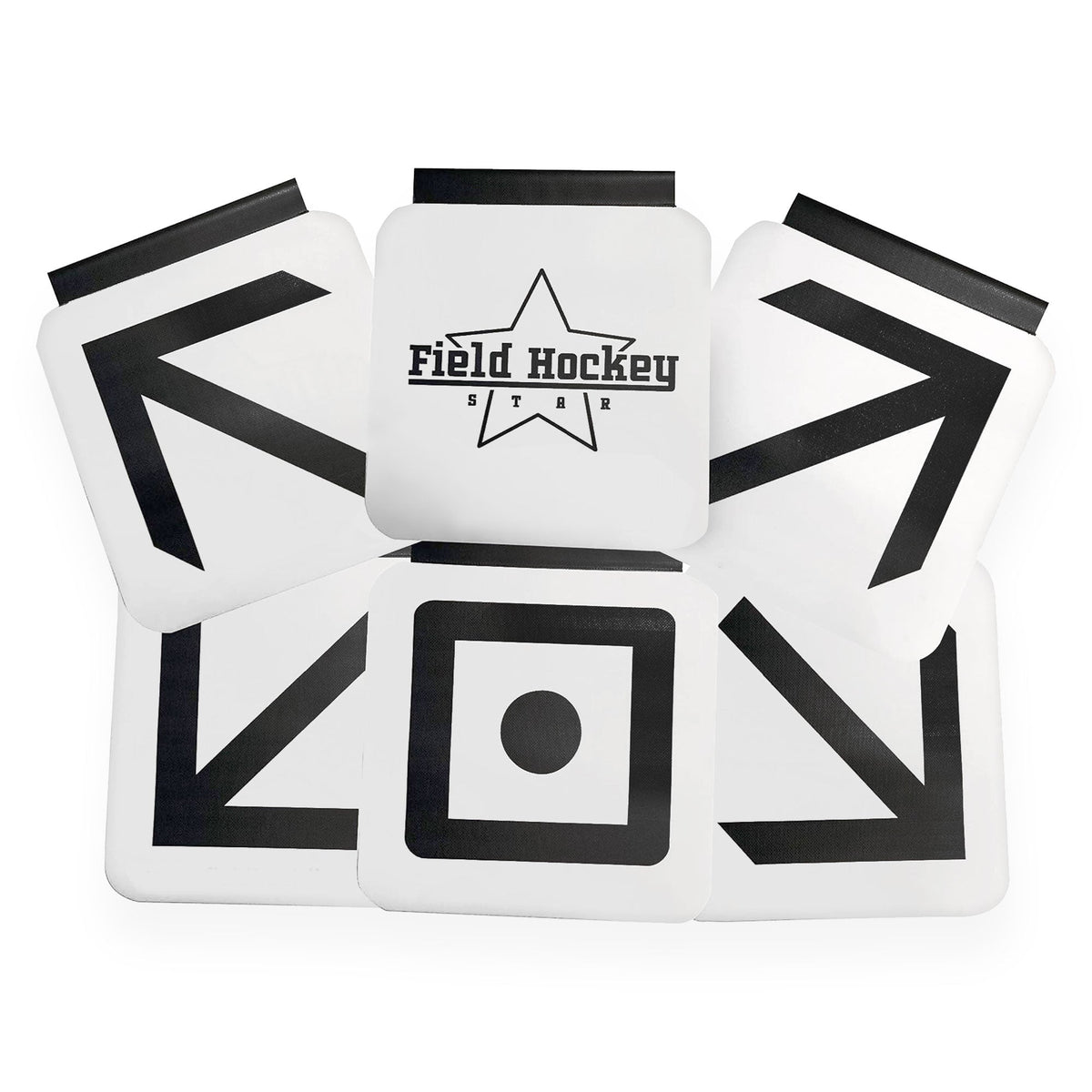
Once your hits are clean, aim at the corners of the goal. A Goal Target attaches six 42 × 42 cm (16.5 × 16.5 in) targets to the goal and gives you a clear aim. Cones placed inside the posts work as a cheaper option. See the target collection for more.
Build the body that hits hard
Two or three short strength sessions a week help, especially for teenagers who are still growing into their bodies:
- Legs: squats and lunges, 3 × 10.
- Rotation: standing cable or band twists, 3 × 10 each side.
- Core: planks and side planks, 3 × 30 seconds.
- Grip and wrists: wrist curls with a light weight, 2 × 15.
Young players should use body weight or light bands and learn the movements properly before adding load.
What you can do at home
You can't practise hitting at home, but you can work on the parts that support it: stable stance, low body position, strength, and clean push passes against a wall to sharpen your eye on the ball. Do practice swings without a ball in a safe outdoor space to rehearse the weight transfer.
FAQ
How do you get more power in a field hockey hit?
Move both hands together at the top of the stick, step into the ball and rotate your hips and shoulders. Power comes from weight transfer and body rotation, not from swinging the arms harder.
Where should the ball be when I hit?
Slightly ahead of your front foot and about a stick-length from your body. That lets you strike it at the bottom of the swing.
Can I practise hitting at home?
No. Hitting needs a pitch, a goal or backstop and space with nobody in front of you. At home, focus on strength, stance and push passing instead.
Is hitting allowed in indoor hockey?
Indoor hockey normally uses pushes rather than hits. Rules vary, so check your league's rules.
How long does it take to hit harder?
With a few focused sessions a week, most players notice cleaner, harder hits within a few weeks. Strength gains take longer.