Quick answer
The fastest way to improve shooting accuracy in field hockey is to shoot at small targets instead of an open goal, and to keep score. Hang targets in the four corners of the goal, take sets of 8–10 shots from fixed spots in the circle, and count how many hit. Start with push shots from close range, then move to slaps, hits and reverse shots from further out. Add a first touch or a dribble before the shot once you are consistent. Do shooting on the pitch with a proper goal, protective gear and nobody near the goal while you shoot.
Key takeaways
- Aim small, miss small. Targets force you to pick a spot every time.
- Keep score in every set. A number shows progress and keeps you honest.
- Low corners are the hardest for goalkeepers. Train to hit them.
- Progress from push to slap to hit, and from standing still to shooting off a receive or dribble.
- Shooting at power belongs on the pitch, not at home.
Why targets work
When you shoot at an empty goal, almost everything counts, so you never learn where the ball really goes. A goal is 3.66 m (12 ft) wide and 2.14 m (7 ft) high, but the space a goalkeeper can't easily reach is much smaller: the corners. Targets turn "somewhere in the goal" into "that corner", which is how shooting works in a game.
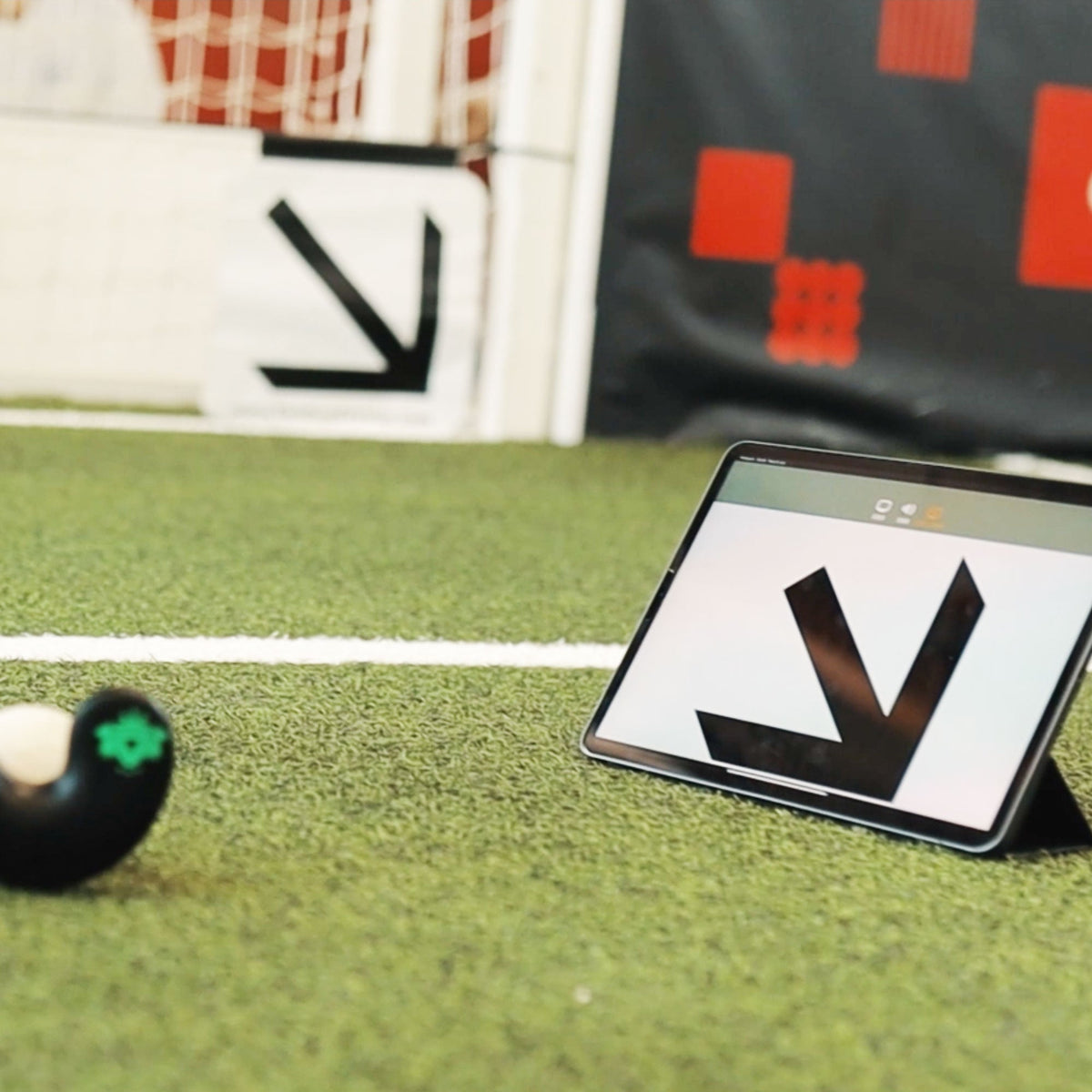
You can use cones or bottles placed just inside the posts, a bib tied in the corner, or a ready-made target. The Goal Target has six 42 × 42 cm targets that attach to the goal, so you can set up corners and middle spots in a couple of minutes.
Setup
- Targets in the low left and low right corners first. Add high corners later for flicks.
- Mark 3 shooting spots with cones: central at about 8 m (9 yd), left and right at about 10 m (11 yd), all inside the circle.
- 10–20 balls, so you don't spend half the session collecting.
- Shin guards and a mouthguard. Nobody behind or beside the goal while shots are taken.
Shooting accuracy drills
1. Push shot corners (warm-up)
From 6–8 m (20–26 ft), push shot at the low left target, then the low right, alternating. 2 sets of 10. Goal: 6 out of 10 on target. This trains aiming without the noise of power.
2. Three-spot round
Take 4 shots from each of the 3 spots, choosing the far corner each time. 12 shots per round, 3 rounds. Use a slap or hit. Write down the score for every round.
3. Receive and shoot
A partner passes from the top of the circle or the side. Receive, set the ball in one touch, shoot at a called corner. 3 × 8 shots. No partner? Pass against a Rebounder placed near the top of the circle, receive the return and shoot.
4. Dribble and shoot
Start at the top of the circle, dribble past a cone "defender", and shoot at a target before the ball goes too wide. 2 × 8 from each side. This is where most game goals come from: shooting while moving, not standing still.
5. Reverse stick finish
From the left side of the circle, receive or dribble onto the reverse and shoot at the far post target. 2 × 8. Reverse shots are powerful and hard for goalkeepers to read, but they need a lot of repetition to be accurate.
6. Called corner
A partner shouts "left" or "right" as you set the ball. You have one touch to adjust and shoot. 2 × 10. This trains looking up and choosing late.
7. Pressure round
Finish every session with 10 shots from mixed spots. Set a score to beat, for example 6 out of 10. If you hit it, raise the bar next time.
A 30-minute shooting session
| Time | Drill | Shots |
|---|---|---|
| 0–8 min | Warm-up and push shot corners | 20 |
| 8–16 min | Three-spot round | 24–36 |
| 16–22 min | Receive and shoot | 16–24 |
| 22–27 min | Dribble and shoot or reverse finish | 16 |
| 27–30 min | Pressure round | 10 |
Quality beats quantity. Once your shots get sloppy from tiredness, stop.
Technique points for accuracy
- Pick the target before you shoot, then look at the ball at contact.
- Front shoulder and front foot point where you want the ball to go.
- Ball position: slightly ahead of the front foot for push shots and hits.
- Follow through towards the target and keep the stick low for low shots.
- Balance: if you fall away, the ball goes wide.
What you can do at home
At home there is no hitting and no lifting. You can still train the aiming habit with push passes: place two cones 50 cm (20 in) apart in front of a wall or rebounder at 4 m (13 ft) and push through the gap, 3 × 10. Move the cones closer as you improve.
Honest note: cones and a wall do the job at home. On the pitch, bottles or bibs in the corners work too. A Goal Target is quicker to set up, clearly visible and gives instant feedback, which makes it easier to stick to scored sessions.
FAQ
How can I improve my shooting accuracy in field hockey?
Shoot at small targets in the corners, keep score, and practise from fixed spots before adding movement. 2–3 short, scored sessions a week work better than lots of random shots.
Where should I aim when shooting?
Usually low and to the corners, especially the far post. Low shots are harder for the goalkeeper and give teammates a chance to deflect.
Can I practise shooting at home?
Only push-pass aiming drills at home. Hits, slaps and flicks need a pitch, a goal, protective gear and supervision.
Do goals count from outside the circle?
No. In standard rules the ball must be played by an attacker inside the circle for a goal to count. Check your league's rules for any youth variations.
How many shots should I take per session?
Around 80–100 quality shots in 30 minutes is plenty. Stop when your technique drops.
Related articles
- How to shoot in field hockey
- How to hit a field hockey ball harder
- Penalty corner basics: injection, stop, shot
In the US? The Rebounder, Skiller and Skills Zone are also available on Amazon.