Quick answer
Use the push pass for short and medium passes where accuracy and speed of release matter most: there is no backswing, so it is quick, hard to read and easy to control. Use the slap hit when you need more distance or pace than a push can give, for example a long switch of play, a pass through a gap to a teammate 20–30 m (22–33 yd) away, or a cross into the circle. The push is your default; the slap hit is your long-range option. Most players should be able to play both off either foot position before they worry about the full hit.
Key takeaways
- The push pass has no backswing. The stick starts on or next to the ball, which makes it fast and accurate.
- The slap hit uses a low, sweeping swing with the hands apart. It adds distance and pace while keeping the ball on the ground.
- Pick by distance, time and pressure: close and under pressure means push; open space and long distance means slap hit.
- In indoor hockey, hitting is generally not allowed, so the push is the main pass. Check your league's rules.
- At home, train the push pass and receiving. Save slap hits for the pitch, where you have space and safe surroundings.
What is the difference?
| Push pass | Slap hit | |
|---|---|---|
| Grip | Hands apart, lower hand partway down the stick | Hands apart, often with the lower hand slid further down; some players slide the top hand down too |
| Backswing | None: the stick stays in contact with the ball | Short and low, close to the ground |
| Typical distance | Up to about 15–20 m (16–22 yd) for most club players | About 20–40 m (22–44 yd), depending on strength and surface |
| Release time | Very quick | Slightly slower; needs a little more space |
| Disguise | High: hard for defenders to read | Medium: the swing gives some warning |
| Best for | Short build-up passes, passes under pressure, indoor hockey | Switches, long passes into space, crosses into the circle |
How to play a push pass
- Hold the stick with hands apart, left hand at the top, right hand lower down.
- Get low. Bend your knees so the stick is close to the ball, not reaching for it.
- Place the stick behind the ball with the ball near your front foot.
- Transfer your weight from back foot to front foot and push the stick through the ball towards the target.
- Follow through low and point the stick at your target.
The power comes from the legs and weight transfer, not from flicking the wrists. If the ball pops up, your stick is probably opening at the end or you are standing too upright.
How to play a slap hit
- Slide your hands apart and lower than for the push, with the stick angled flat towards the ground.
- Position the ball out in front and slightly away from your feet so you have room to swing.
- Take a short, low backswing. The stick stays close to the pitch.
- Sweep through the ball with a long contact, transferring your weight forwards.
- Follow through low, along the line of the pass.
The slap hit is a sweeping action, not a chop. Keeping the stick low is what keeps the ball on the ground and makes the pass easy to receive.
When to use which: a simple decision guide
- Teammate is close (under about 15 m / 16 yd) and a defender is near you: push pass. You need a fast release more than power.
- Long switch from one side of the pitch to the other: slap hit. A push will be too slow and get intercepted.
- Pass into space for a runner: push if the space is close; slap hit if the space is far and the runner is already moving.
- Cross into the circle from the baseline area: slap hit gives the pace a teammate needs to deflect it.
- Receiving and passing in one movement: usually a push, because there is no time for a backswing.
- Indoor hockey: push. Check your league's rules on hitting.
Drills to train both
At home (push pass only)
Stand 3–5 m (10–16 ft) from a wall or a Rebounder.
- Accuracy push: 3 × 1 minute, aiming at a taped square about 30 cm (1 ft) wide. Count how many hit the square.
- Receive and push: 3 × 1 minute. Stop the ball, take one touch to set it, push it back.
- One-touch push: 3 × 30 seconds. Push the ball straight back without stopping it.
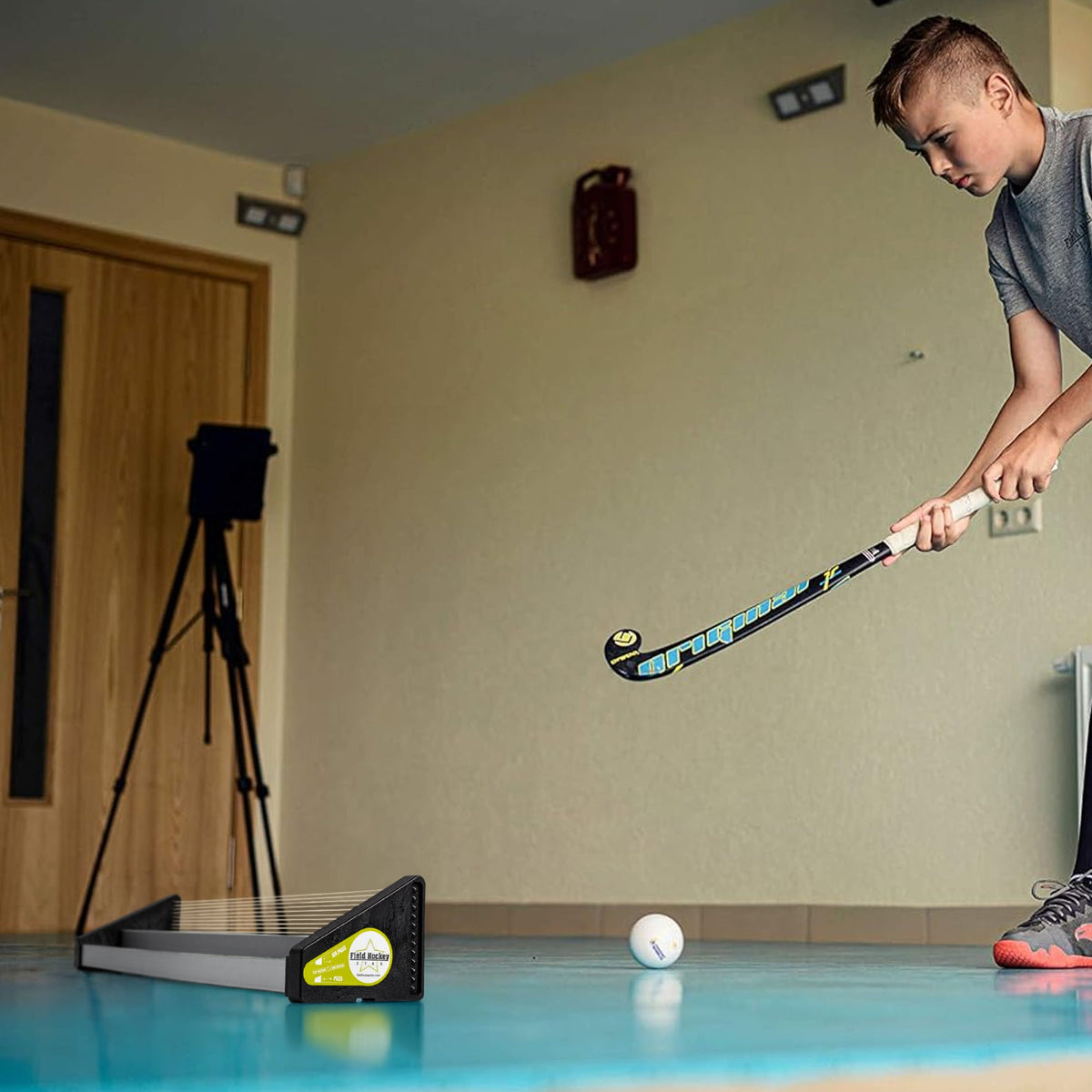
Keep the ball on the floor and don't hit indoors. A wall is free and works well; the rebounder helps when you have no suitable wall or want to train on tiles inside.
On the pitch (both)
- Distance ladder: with a partner, start 10 m (11 yd) apart and push 10 passes. Step back 5 m (5.5 yd) each round. When the push starts to lose pace, switch to slap hits. Find your own crossover distance.
- Switch drill: two players about 30 m (33 yd) apart across the pitch. Receive, take one touch, slap hit to the partner. 10 each.
- Pressure push: a third player closes you down as you receive. You must push within two touches.
Practise slap hits with enough space, a clear area behind your target and proper equipment. Never hit towards people who are not ready.
Common mistakes
- Using a slap hit for every pass: it slows down your release and gives defenders time to intercept.
- Lifting the ball by accident: usually from an open stick face at the end of the swing or from standing too tall.
- No weight transfer on the push: passes die halfway. Step into it.
- Looking only at the ball: scan before you receive so you already know which pass you want.
FAQ
Is a slap hit the same as a hit?
No. A full hit uses hands together at the top of the stick and a bigger backswing. A slap hit uses hands apart and a low, sweeping swing. It is easier to control and quicker to play.
Which pass should beginners learn first?
The push pass. It teaches body position, weight transfer and accuracy, and it is the pass you will use most often in games.
Can you slap hit in indoor hockey?
Generally no. Indoor hockey is played mainly with pushes, and hitting is not allowed in most indoor competitions. Check your league's rules.
How far can you push pass?
It depends on strength and surface, but many club players can push accurately up to about 15–20 m (16–22 yd). Beyond that, a slap hit is usually the better choice.
Can I practise slap hits at home?
Only outdoors with plenty of space and a safe area behind the target. Indoors, stick to push passes and receiving.
Related articles
- How to push pass in field hockey
- How to do a slap hit in field hockey
- Field hockey passing drills you can do alone
In the US? The Rebounder, Skiller and Skills Zone are also available on Amazon.