Quick answer
You can train most field hockey passing skills alone with a wall or a rebounder and a few cones. The core drills are forehand push and receive, reverse stick receiving, one-touch passing, passing on the move and accuracy work to a target. Stand 3–5 m (10–16 ft) away, work in 1-minute sets, and count clean passes so you can track progress. Indoors, keep every pass on the ground; save slap hits and aerials for the pitch with space and supervision.
Key takeaways
- A solid wall is a free passing partner. A rebounder works where you can't use a wall.
- Train receiving as much as passing. A clean first touch makes the next pass easier.
- Use both sides: forehand and reverse stick.
- Short, focused sets (30–60 seconds) with a score keep quality high.
- Add movement and decisions once the basic technique is clean.
What you need
- A stick and 1–3 balls.
- A solid wall with nothing breakable nearby, or a Rebounder.
- 4–6 cones or markers and some tape for a target.
- A flat, smooth surface of at least 2 × 4 m (6.5 × 13 ft). Flooring Tiles help on rough floors.
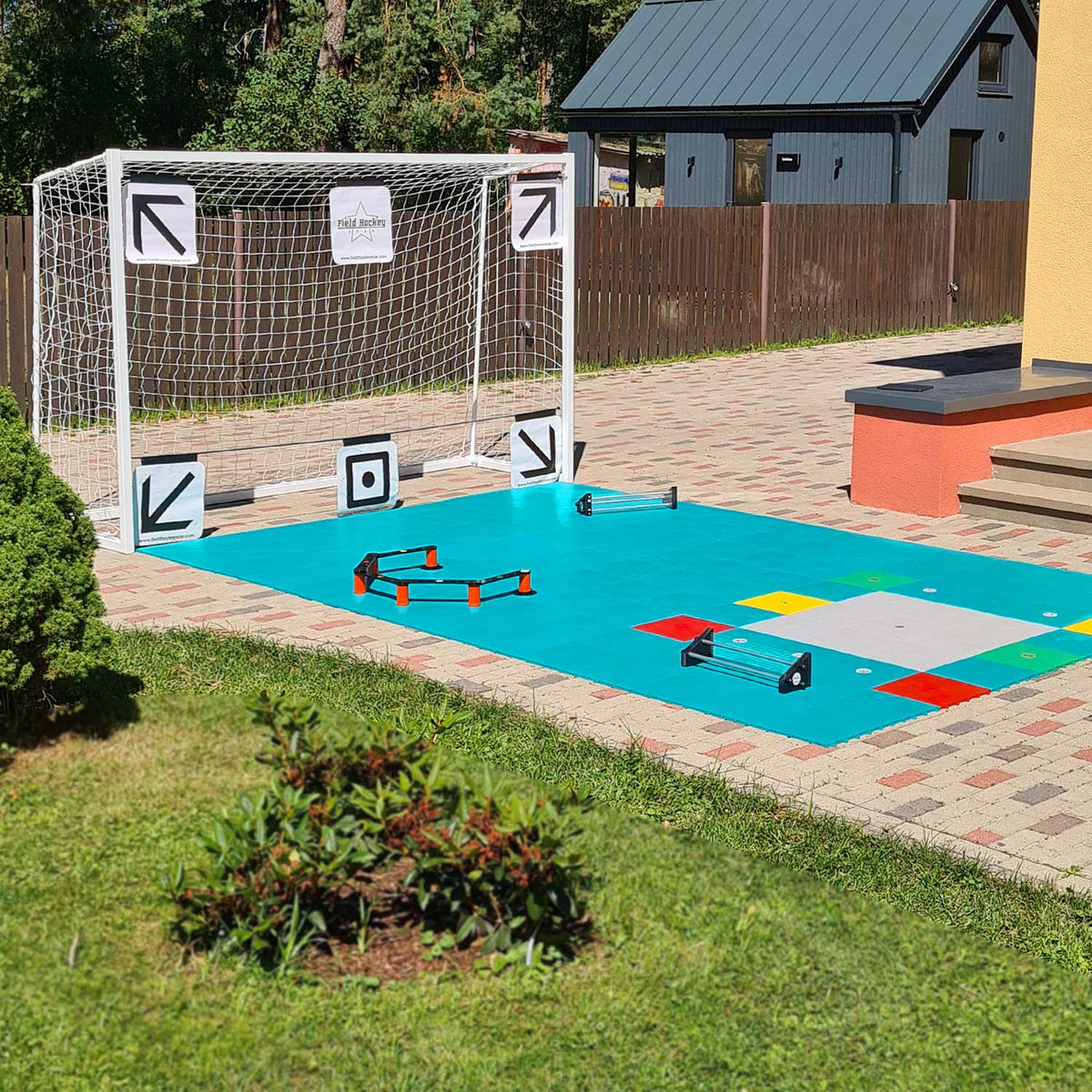
Wall or rebounder? A wall is free and works well if it is solid and you are allowed to use it. A rebounder helps indoors, in rented homes, on tiles away from walls, or when you want to train reverse-side receiving at different angles. The Passing Kit pairs a Rebounder with two packs of Flooring Tiles (4 m²) for a full passing lane.
10 solo passing drills
1. Forehand push and receive
From 3–4 m (10–13 ft), push the ball to the wall or rebounder, receive it on your forehand, set it, and push again. 3 × 1 minute. Count clean receptions.
2. Reverse stick receive
Angle your body so the ball returns to your left side. Receive on the reverse stick, move the ball to your forehand, push. 3 × 1 minute.
3. One-touch passing
Push the ball straight back without stopping it. Start slow, then increase speed. 3 × 30 seconds. Stop when accuracy drops.
4. Target push
Tape a 30 × 30 cm (1 × 1 ft) square on the wall, or place a cone in front of the rebounder as a target. 20 pushes from 4 m (13 ft). Score how many hit.
5. Distance ladder
Start at 3 m (10 ft). Do 10 passes. Step back 1 m (3 ft) and repeat up to 6 m (20 ft). The push must stay on the ground and keep its pace.
6. Receive and turn
Receive the ball, turn 90° away with it, dribble to a cone 2 m (6.5 ft) away, come back and pass again. 3 × 1 minute, alternating the turn direction.
7. Pass on the move
Dribble parallel to the wall, push the ball at an angle ahead of you, keep moving, and receive it further along. With a rebounder, move sideways across it. 4 lengths each direction.
8. Two-touch rhythm
Receive with one touch, pass with the second. No extra touches. 3 × 1 minute. This builds the habit of passing quickly in games.
9. Gate passing
Set two cones 50 cm (20 in) apart about 2 m (6.5 ft) in front of the wall or rebounder. The ball must pass through the gate both ways. 3 × 1 minute.
10. 60-second challenge
Count clean passes and receptions in 60 seconds. Write the number down and try to beat it next session. This is your progress test.
Sample 25-minute session
| Time | Drill |
|---|---|
| 0–4 min | Warm-up: jog, lunges, easy ball touches |
| 4–8 min | Drill 1 forehand push and receive |
| 8–12 min | Drill 2 reverse stick receive |
| 12–15 min | Drill 4 target push |
| 15–19 min | Drill 7 pass on the move |
| 19–22 min | Drill 3 one-touch passing |
| 22–25 min | Drill 10 60-second challenge |
Do this 2–3 times a week and swap in drills 5, 6, 8 and 9 every couple of weeks.
Technique reminders
- Get low: bend your knees to receive. Standing tall causes bounces off the stick.
- Soft hands on the receive: let the stick give a little to cushion the ball.
- Weight transfer on the push: step towards the target; don't just use your arms.
- Head up between passes: glance up before every pass, as you would in a game.
Honest limits of solo passing
- Walls and rebounders return the ball predictably. Real passes from teammates vary in pace and angle, so you still need team practice.
- You can't practise reading a teammate's run alone. Use club sessions for that.
- Long passes, slap hits and aerials need a pitch, space and supervision. Indoors, keep it to push passes.
FAQ
How can I practise field hockey passing without a partner?
Use a solid wall or a rebounder. Push, receive on both sides, and add one-touch and on-the-move drills. Count clean passes to track progress.
How far from the wall should I stand?
Start at 3–4 m (10–13 ft). Move further back once your passes stay on the ground and your receiving is clean.
Is a rebounder better than a wall?
Not always. A good wall works very well and costs nothing. A rebounder helps when you can't use a wall, want to train on tiles indoors, or need more angles for reverse-side receiving.
Can I practise slap hits alone at home?
Only outdoors with plenty of space and nothing behind the target that could be damaged or hurt. Indoors, stick to push passes.
How often should I do passing drills?
2–3 sessions of 20–25 minutes a week, on top of team practice, is enough to see clear progress in a few weeks.
Related articles
- How to receive the ball in field hockey (forehand and backhand)
- 10 rebounder passing drills for solo field hockey training
- Wall vs rebounder for field hockey: honest comparison
In the US? The Rebounder, Skiller and Skills Zone are also available on Amazon.