Quick answer
To receive on the move without losing speed, take the ball in front of your body and slightly to the side you are running towards, so your first touch already carries it forward. Keep your stick low and angled, let the ball come into the stick instead of stopping it dead, and scan before the ball arrives. Practise with a wall or rebounder by passing, moving a few steps, and receiving as you run onto the return. Start at walking pace from 4 m (13 ft), then add speed and distance. Three or four 10-minute sessions a week build the habit.
Key takeaways
- Receive the ball out in front, not under your feet, so you can keep running.
- Your first touch should move the ball into space, not stop it.
- Angle the stick to guide the ball forward on the forehand and reverse stick.
- Scan before the pass arrives so you already know where to go.
- Build up in stages: walk, jog, then run at match speed.
Why players slow down when receiving
Most players stop to receive because they want to "kill" the ball. That feels safe, but it gives defenders time to close you down. In a match, a good receive on the move can beat the first defender before they get set. The three common causes:
- Ball too close to the body: you have to stop, step back or chop your stride.
- Stick too upright or too stiff: the ball bounces off and you have to chase it.
- No scan: you receive, then look up, then decide. That costs a second.
Technique
Forehand receive on the move
- Run with your body slightly open to the passer.
- Stick low, head of the stick on the ground, left hand at the top, right hand lower down the grip.
- Angle the stick so the ball is guided forward in the direction you are running.
- Meet the ball in front of your right foot and keep soft hands, so it stays close to the stick.
Reverse stick receive on the move
- Turn the stick over so the flat face points to your left.
- Take the ball in front of your left foot, with the stick angled to guide it forward.
- Keep your right hand relaxed and let the left hand control the angle.
- Move the ball onto your forehand with your next touch if you need to pass or go to goal.
Drills
1. Pass and slide (4 minutes)
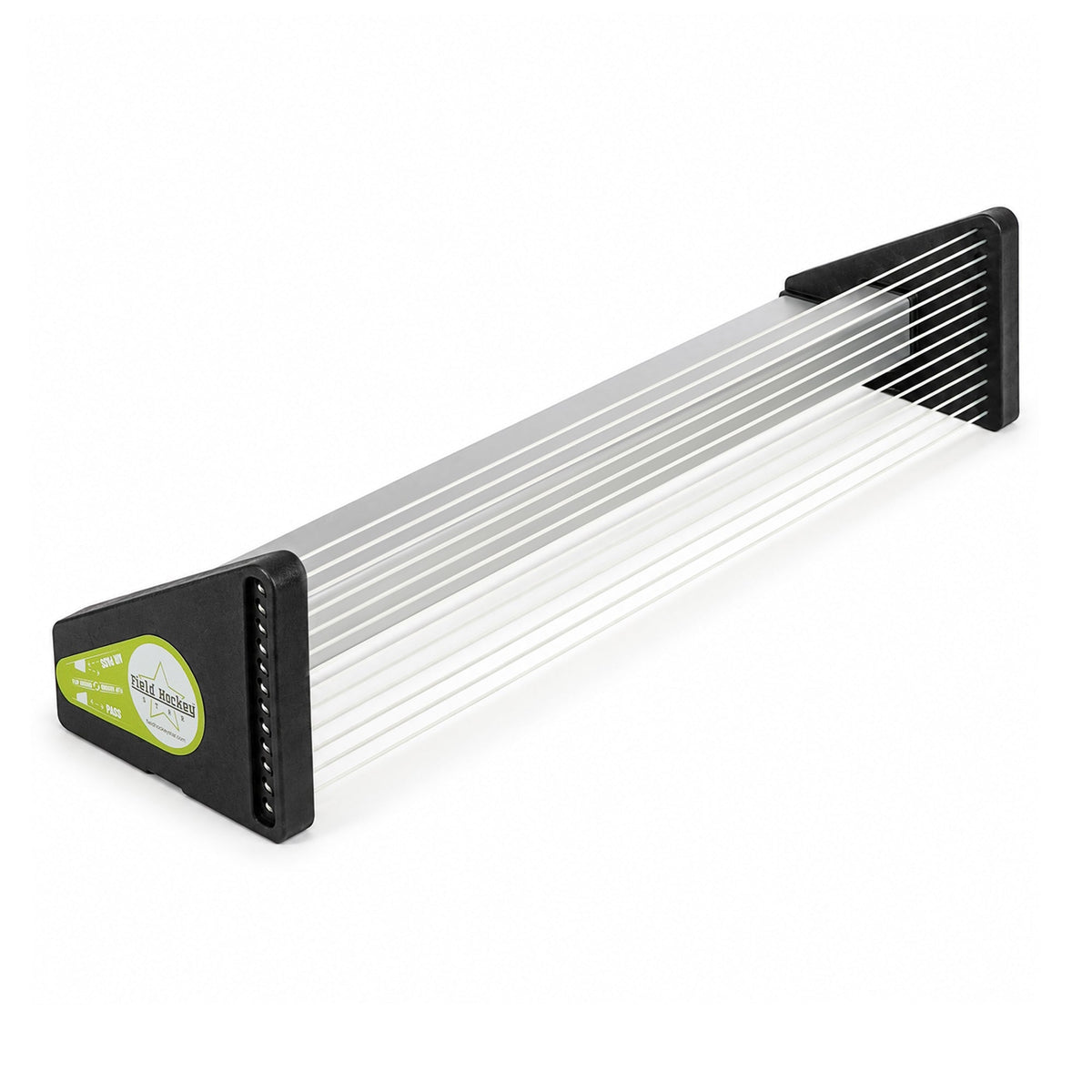
Stand 4 m (13 ft) from a wall or a Rebounder. Push pass, then take two side steps to the right and receive the return on the forehand as you move. Push again and slide back to the left. 4 × 45 seconds, 15 seconds rest. Then repeat moving left and receiving on the reverse stick.
2. Diagonal run (4 minutes)
Place two cones 3 m (10 ft) apart, parallel to the wall, 5 m (16 ft) back. Start at cone A, pass on an angle so the ball comes back towards cone B, and run to receive it before it reaches the cone. Dribble back to cone A and repeat. 8 reps each way. Count how many receives go forward without a stop.
3. Receive and eliminate (3 minutes)
Put a cone 2 m (6.5 ft) in front of the wall or rebounder as a "defender". Pass, receive on the move, and take your first touch past the cone on either side. Alternate sides. 10 reps.
4. Called direction (3 minutes)
Ask a partner to call "left" or "right" as the ball comes back, or use the free Field Hockey App. Your first touch goes in the called direction. 3 × 40 seconds. This trains scanning and quick decisions.
Build up step by step
| Week | Distance | Speed | Goal |
|---|---|---|---|
| 1–2 | 4 m (13 ft) | Walking | Clean receive in front of the body |
| 3–4 | 5–6 m (16–20 ft) | Jogging | First touch goes forward every time |
| 5–6 | 6–8 m (20–26 ft) | Running | Add the reverse stick and called directions |
For longer distances you need a bigger space such as a driveway or the pitch. A Passing Kit combines a Rebounder with 4 m² of flooring tiles if you want a dedicated surface at home.
Honest notes
- A wall works fine for all of these drills if you have a safe, solid one.
- A rebounder returns the ball at a predictable angle. A partner adds the variety of real passes, so mix both when you can.
- Indoors, keep every pass on the floor. Hard passes and hits belong on the pitch.
FAQ
How do I receive the ball while running in field hockey?
Take the ball in front of your body, with a low, angled stick and soft hands, so your first touch carries it forward in the direction you are running.
Should I stop the ball when I receive it?
Not if you have space. Stopping the ball dead gives defenders time. Receive it into space unless you are under heavy pressure and need to protect it.
Where should the ball be when I receive on the reverse stick?
In front of your left foot, with the stick turned over and angled forward so the ball keeps moving.
Can I practise receiving on the move alone?
Yes. A wall or rebounder lets you pass, move and receive the return on your own. Start slow and short, then build speed and distance.
Related articles
- How to receive the ball in field hockey
- Backhand receiving: the most common mistakes
- One-touch passing drills
In the US? The Rebounder, Skiller and Skills Zone are also available on Amazon.