Quick answer
To improve passing accuracy in field hockey, fix three things: your body position, your follow-through and your aim. Get your feet and shoulders lined up with the target, keep the ball out in front of your body, and finish the pass with your stick pointing where you want the ball to go. Then train with small targets and a clear score: passes through a gate, at a mark on a wall, or to a teammate's stick. Start at 3–5 m (10–16 ft) and only add distance and speed when you hit 8 out of 10.
Key takeaways
- Most inaccurate passes start with the feet, not the hands.
- Finish with the stick pointing at the target and hold it for a moment while you learn.
- Aim at something small: a gate, a cone, a stick, a spot on the wall.
- Score every set. Accuracy you don't measure is hard to improve.
- Accuracy first, then speed, then distance.
Why passes go off target
| Problem | Typical result | Fix |
|---|---|---|
| Ball too close to the feet | Weak pass, pulled to the side | Keep the ball about a stick length in front, slightly right of your front foot |
| Shoulders facing the wrong way | Pass goes where the shoulders point | Turn your front shoulder towards the target before passing |
| Short, stabbing follow-through | Ball wobbles or bounces | Push through the ball and finish low, pointing at the target |
| Looking up too early | Mishit | Watch the ball until it leaves the stick, then look |
| Poor first touch | Rushed, off-balance pass | Receive the ball into a good passing position first |
The technique checklist
For a forehand push pass, the most common pass in the game:
- Feet: about shoulder width apart, left foot forward for a right-handed grip, pointing roughly at the target.
- Ball: out in front of your body, so your arms are not cramped.
- Stick: in contact with the ball before you push. A push has no backswing.
- Weight: move your weight from the back foot to the front foot as you push.
- Finish: stick low, pointing at the target. Hold the finish for one second in practice.
The same ideas apply to the slap hit and the hit on the pitch: line up the body, then follow through towards the target.
Accuracy drills
Drill 1: Gate passing (5 minutes)
Set two cones 1 m (3 ft) apart, 5 m (16 ft) away. Push pass through the gate. Do 3 sets of 10 and count how many go through cleanly. When you score 8/10, narrow the gate to 60 cm (2 ft) or move back to 8 m (26 ft).
Drill 2: Wall spot (5 minutes)
Mark a spot on a wall with tape, about 30 cm (1 ft) wide at ball height. From 4 m (13 ft), pass at the spot, control the return and pass again. Count hits in 60 seconds. Do 3 rounds and write down the best score.
Drill 3: Rebounder target lanes (5 minutes)
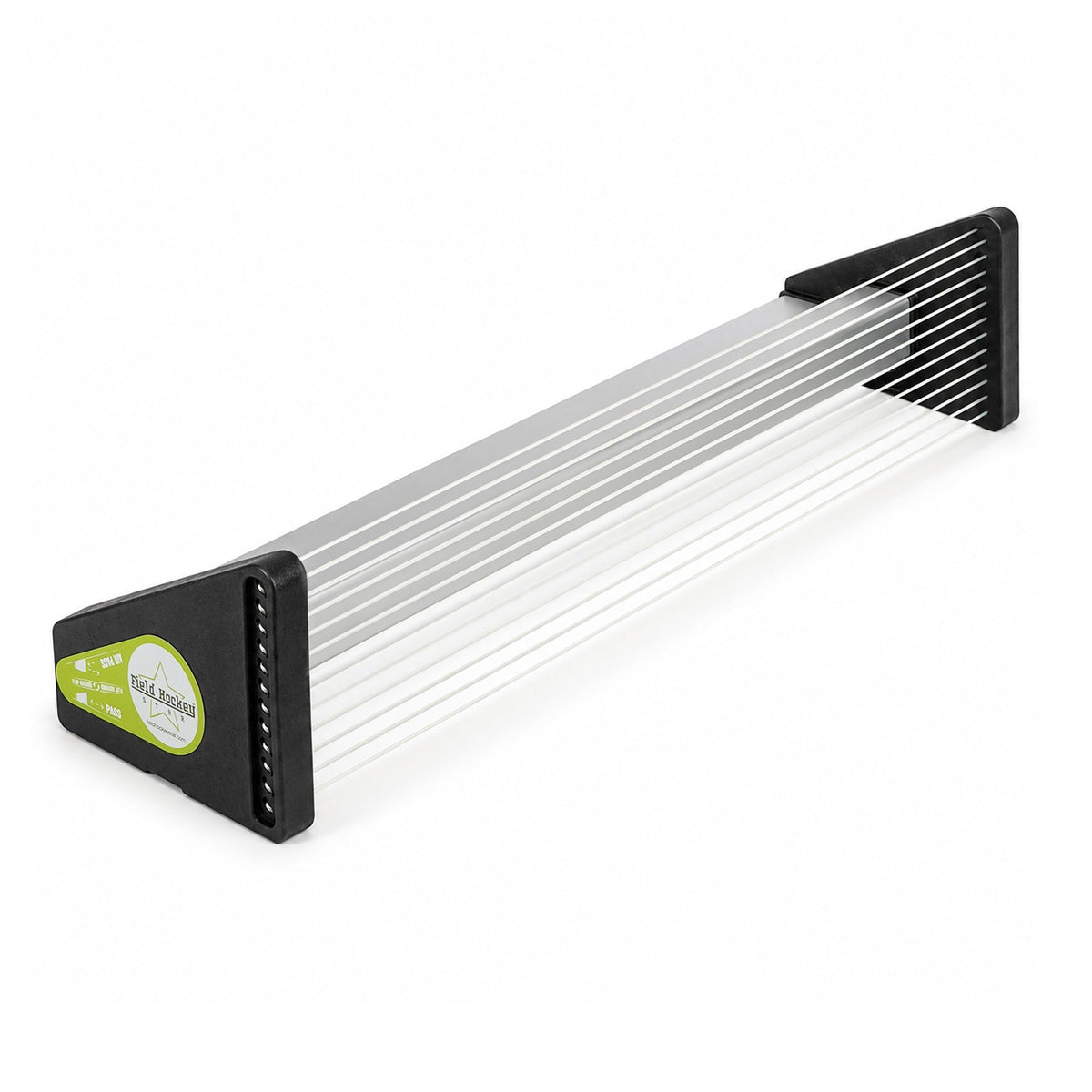
Set a Rebounder 4–5 m (13–16 ft) away, with a cone 1 m (3 ft) to the left and right of where you stand. Pass, then move to the next cone before the return arrives, receive and pass again. Moving between passes makes you set your feet each time, which is exactly where accuracy breaks down in games.
Drill 4: Pass off the dribble (5 minutes)
Dribble towards the gate from 10 m (33 ft) away. At a cone 6 m (20 ft) from the gate, pass through it without stopping. This trains accuracy while moving, which is what matches demand.
Drill 5: Target practice on the pitch
On the pitch, with supervision, you can add slap hits and hits at targets. A Goal Target attaches six 42 × 42 cm (16.5 × 16.5 in) targets to a goal. Mainly a shooting aid, it also works as a passing target: pick a corner target and pass from the top of the circle. A pair of cones in the goal mouth works too if you don't have one.
Drill 6: Partner passing with a call (with a teammate)
Stand 8 m (26 ft) apart. Your partner holds the stick out to the left or right and you must pass to that side. It trains you to aim at a real stick, not just "towards" a player.
A simple 3-week plan
- Week 1: Drills 1 and 2, three times. Slow, perfect technique, hold the finish.
- Week 2: Add Drill 3. Move faster between passes.
- Week 3: Add Drill 4, and Drill 5 or 6 on the pitch. Retest the wall spot score from week 1.
Honest notes
- A wall and two cones are enough to train accuracy. Training aids make it easier to practise indoors or without a suitable wall.
- At home, keep to push passes along the ground. Hits and lifted passes are for the pitch.
- Accuracy in practice is the first step. Team practice teaches you to be accurate while defenders press you.
FAQ
Why do my passes always go to the left or right?
Usually your shoulders or feet are not facing the target, or the ball is too close to your body. Check your setup before you look at your hands.
Should I practise accuracy or power first?
Accuracy first. A hard pass that misses is a turnover. Add power once you hit your target 8 out of 10 times.
How far should I stand from the target?
Start at 3–5 m (10–16 ft). Move to 8–10 m (26–33 ft) once you are consistent, and longer on the pitch.
Can I improve passing accuracy at home?
Yes. Push passes at a wall spot, through a cone gate or against a rebounder are ideal home drills.
How do I improve backhand passing accuracy?
Use the same drills on the reverse side, starting closer to the target. Keep the ball out in front and finish pointing at the target.
Related articles
- How to push pass in field hockey
- 10 rebounder passing drills for solo training
- Improve your passing accuracy with the Rebounder
In the US? The Rebounder, Skiller and Skills Zone are also available on Amazon.