Quick answer
The best way to help your child get better at field hockey at home is to make practice short, regular and fun. Aim for 10–20 minutes, 3–4 times a week, on a flat surface with the ball on the ground. Ask the coach for one or two things to work on, and build home sessions around those. Your job is to set up the space, be a passing partner or timekeeper, and praise effort, not to coach technique. Keep it your child's choice, and track small wins so they can see their progress.
Key takeaways
- Short and frequent beats long and rare: 10–20 minutes, 3–4 times a week.
- Ask the coach what to work on, so home practice supports team practice.
- Be a helper and a fan, not a second coach.
- Games and challenges motivate kids more than repetitive drills.
- At home, keep the ball on the ground. No hitting and no lifting.
Start with the coach
Before you set up anything, ask your child's coach a simple question: "What is the one thing they should practise at home?" Most coaches are happy to answer. It might be receiving on the reverse stick, keeping the ball further out in front, or passing with more pace. This keeps home practice aligned with what the team is doing, and your child won't get mixed messages.
Set up a simple space
- Space: about 2 × 3 m (6.5 × 10 ft) of flat floor in a garage, basement, hallway or patio.
- Surface: smooth concrete or hard floor works. If the floor is rough or needs protecting, flooring tiles cover 2 m² (21.5 ft²) per pack of 18.
- Basics: stick, 2–3 balls, 4 cones or plastic cups, and a wall to pass against.
- Safety: move anything breakable. Shin guards are a good idea for younger kids.
A 15-minute home session for kids
| Time | Activity | Parent's role |
|---|---|---|
| 2 min | Warm-up: jog, side steps, easy ball touches | Join in |
| 4 min | Dribbling around cones, Indian dribble on the spot | Call "stop" and "go", count touches |
| 4 min | Push passes and receiving against a wall, 3 m (10 ft) away | Count clean passes |
| 3 min | Coach's focus skill | Watch and encourage |
| 2 min | Challenge: beat yesterday's score | Write the number down |
Turn practice into games
Kids practise longer when it feels like play. A few ideas:
- Touch race: how many Indian dribble touches in 30 seconds? Try to beat the record.
- Colour calls: place coloured cones around the area. Call a colour, and your child dribbles to it and back.
- Wall target: tape a square on the wall. Points for every push pass that hits it.
- Parent vs kid: a 1v1 where you try to touch the ball with your foot while they shield it. Go easy.
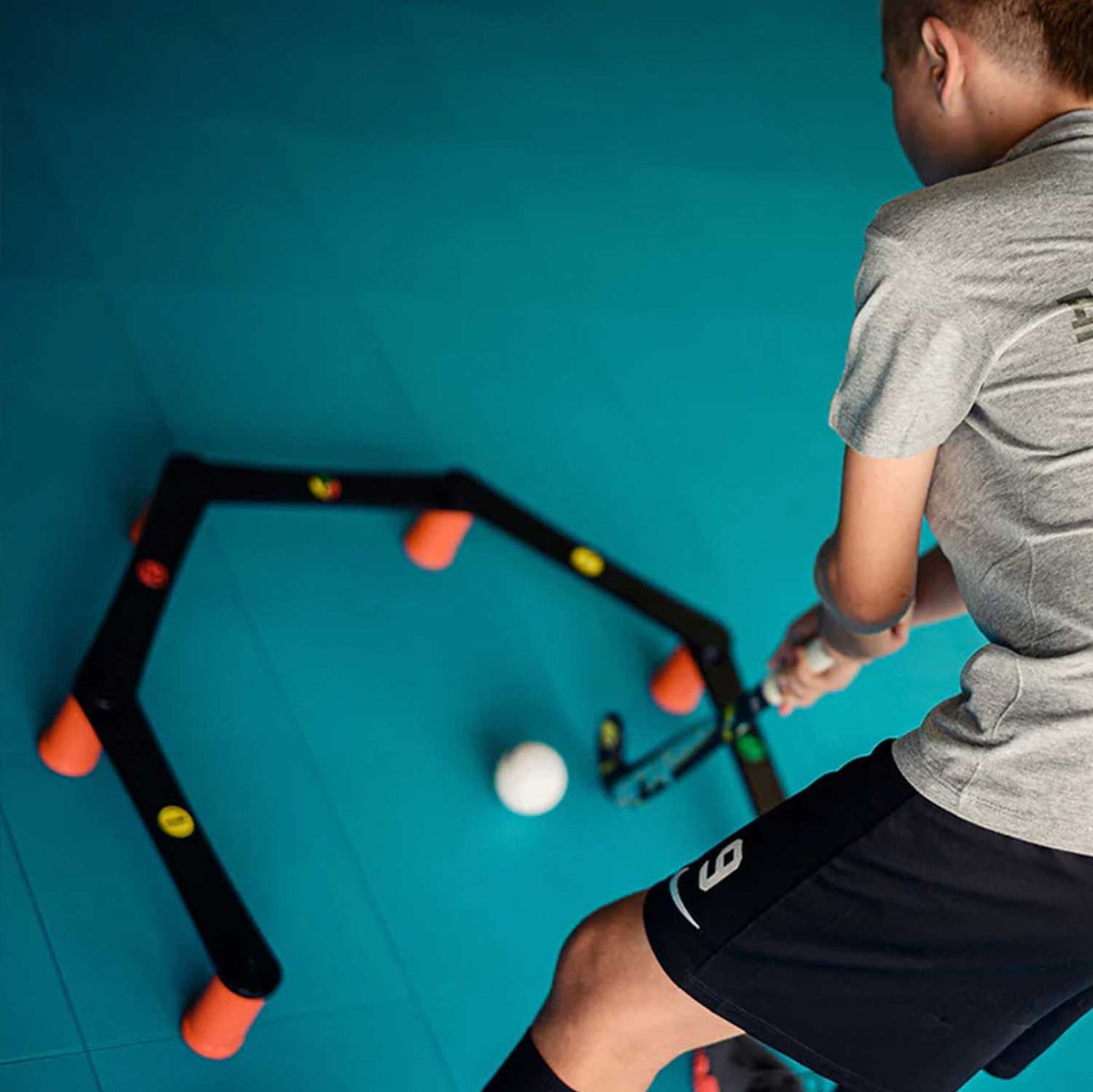
The free Field Hockey App works with the Skiller to call colours and numbers, so kids can train reaction and head-up dribbling even when you are busy.
When there's no good wall
Passing is the hardest thing to practise alone, because the ball has to come back. Options:
- A brick or concrete wall: free and works well. Check that it can take a ball and that the neighbours don't mind the noise.
- You: roll the ball back by hand or with a stick. Great for younger kids.
- A rebounder: the Rebounder sends push passes back along the ground and works indoors or on tiles.
If your child is keen on several skills, the Training Kit combines the Rebounder, a Skills Zone and a Skiller. Only buy it if they are already practising regularly. Equipment won't create motivation on its own.
Your role as a parent
Do
- Praise effort and specific progress: "Your reverse receiving is much cleaner."
- Let your child choose when to practise within a weekly plan.
- Keep sessions short and stop while it is still fun.
Avoid
- Correcting technique in a way that contradicts the coach.
- Talking about mistakes from the last game during practice.
- Forcing sessions when your child is tired or not interested.
FAQ
How often should my child practise field hockey at home?
10–20 minutes, 3–4 times a week, is plenty for most kids. Regular short sessions work better than one long session at the weekend.
What can my child practise at home?
Dribbling, push passing, receiving on both sides and footwork. Keep the ball on the floor. Hitting and lifted balls belong on the pitch.
I don't know field hockey. Can I still help?
Yes. You can set up the space, time the drills, count scores and pass the ball back. Ask the coach what to focus on.
Do we need special equipment?
No. A stick, a ball, a few cones and a wall are enough to start. Training aids add variety and help when there is no wall or space is tight.
What if my child doesn't want to practise?
Don't force it. Make it a game, practise together, or take a break. Motivation often comes back when practice feels like play.
Related articles
- Field hockey for beginners: a parent's guide
- What age to start field hockey
- Small-space field hockey drills
In the US? The Rebounder, Skiller and Skills Zone are also available on Amazon.