Quick answer
To prepare for high school field hockey tryouts in the US, start 6–8 weeks before tryouts, which for most fall programs means early summer. Split the time between fitness (running, sprints and agility) and ball skills (first touch, push passing and dribbling with the head up). Make sure paperwork such as the sports physical is done, the equipment is ready and the player knows what the coach will be looking for. Coaches usually notice attitude, effort and clean basic skills more than fancy moves.
Key takeaways
- Most US high school field hockey is a fall sport, so tryouts usually happen in August. Check your school's dates early.
- Start 6–8 weeks out with 3–4 short skill sessions and 2–3 fitness sessions a week.
- Fitness tests vary by program. Ask the coach or older players what to expect.
- Get paperwork and equipment sorted well before day one.
- Coaches look for effort, coachability and solid basics, not just the most skilled player.
What coaches usually look for
Every coach is different, but most evaluate players on a mix of:
- First touch: can the player control a pass cleanly on forehand and reverse stick?
- Passing: accurate push passes, and for older players, slap hits over longer distances.
- Fitness: can they keep working hard at the end of a long session?
- Game sense: do they move to space, support teammates and track back?
- Attitude: listening, hustle, encouraging others, and reacting well to mistakes.
A player with average skills who works hard, listens and improves during tryouts is often an easier pick than a skilled player who switches off.
The 6-week plan
| Weeks | Skills (3–4× per week, 20–30 min) | Fitness (2–3× per week) |
|---|---|---|
| 1–2 | Push passing and receiving, basic dribbling, Indian dribble | Easy runs 15–20 min, core and leg strength |
| 3–4 | Receiving on the reverse stick, dribbling with head up, pull-backs | Interval runs, 6–8 × 30 m (33 yd) sprints |
| 5–6 | Receive and pass in one movement, V-drag, quick change of direction | Shuttle runs, agility drills, repeated sprints with short rest |
| Tryout week | Short, sharp touches only | Light; rest the day before |
Skills your child can practise at home
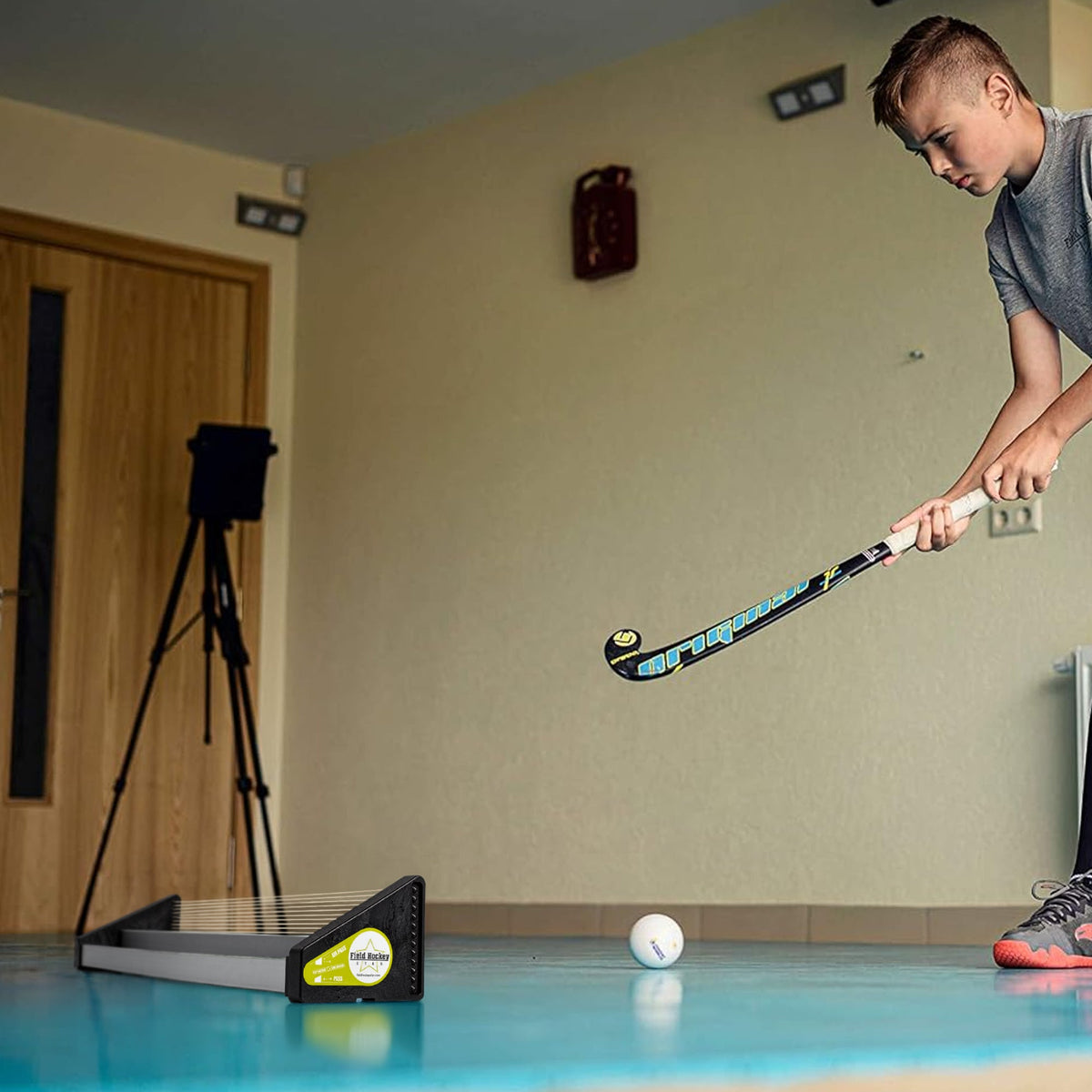
- Wall passing: 3–5 m (10–16 ft) from a wall, 3 × 2 minutes forehand receive and push, 3 × 2 minutes reverse stick receive. A Rebounder helps if there is no suitable wall or you want to train inside.
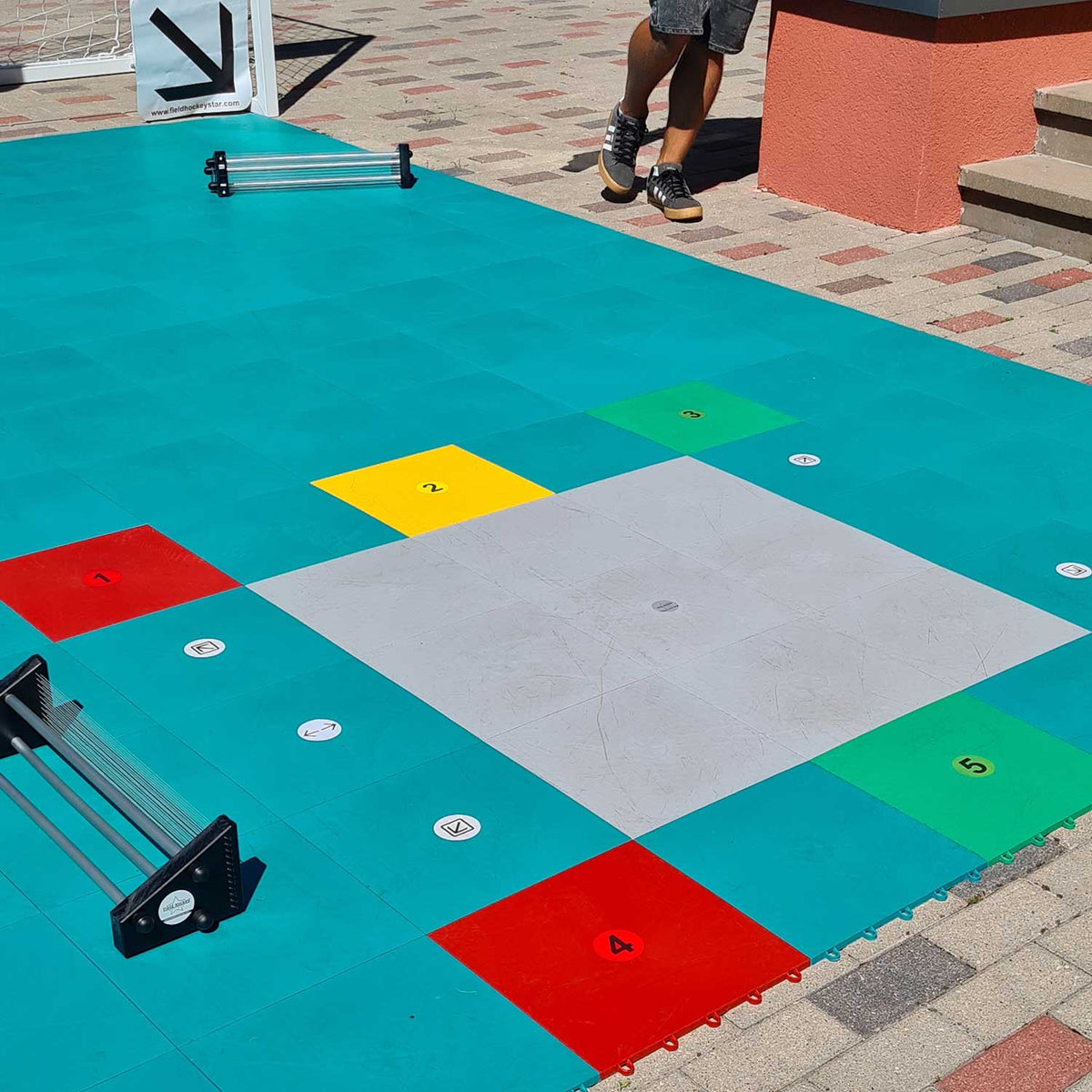
- Head-up dribbling: a parent calls colours or numbers while the player dribbles. A Skiller with the free Field Hockey App can make the calls instead.
- Cone slalom: 6 cones, 1 m (3 ft) apart, timed runs. Track the best time each week.
- Small-space footwork: quick direction changes around 4 cones in a 2 m (6.5 ft) square.
Indoors, keep the ball on the floor. Hitting and slap hits belong on a field with space and supervision.
If you want a single home setup for passing, ball control and footwork, the Training Kit combines the Rebounder, Skills Zone and Skiller. It is a nice-to-have: a wall, some cones and a consistent plan are enough to prepare well.
Fitness: what to expect
Tryout fitness tests differ by school and coach. Some programs use a timed run, some use shuttle runs or a beep test, and some simply watch how players hold up through drills and scrimmages. Ask the coach, team captains or the athletic department what is typical. Train for repeated sprints, because field hockey is a game of short bursts.
Paperwork and equipment checklist
- Sports physical: most schools require a current pre-participation physical. Book it early in summer.
- School forms: registration, emergency contacts, concussion information forms. Check with the athletic department.
- Stick: the right length for the player.
- Shin guards and mouthguard: required. Many US high school programs also require protective eyewear; check your state's and school's rules.
- Cleats or turf shoes: depending on the surface.
- Water bottle, snacks, sunscreen: August tryouts can be hot.
Tryout week tips
- Sleep and hydrate: start in the days before, not the night before.
- Arrive early: warm up properly and be ready when the coach starts.
- Talk on the field: calling for the ball and encouraging teammates is noticed.
- Move on from mistakes: everyone makes them. Coaches watch how players react.
- Ask for feedback: whatever the result, ask the coach what to work on next.
If your child doesn't make the team
It is hard, but it is not the end. Ask for specific feedback, look for club teams, clinics and winter indoor hockey, and build a plan for next year. Many players who miss out one year make the team the next.
FAQ
When are high school field hockey tryouts?
Most US high school field hockey is played in the fall, so tryouts are usually in August. Exact dates vary by state and school, so check with the athletic department.
How long before tryouts should my child start preparing?
About 6–8 weeks is ideal. That gives time to build fitness and sharpen basic skills without rushing.
Can you make a high school team without club experience?
Yes, especially at JV level. Coaches often take athletic, hard-working players who are keen to learn.
What do I need to bring to tryouts?
A stick, shin guards, a mouthguard, any required eyewear, suitable shoes, water and the completed school paperwork, including the sports physical.
Can my child practise for tryouts at home?
Yes. Passing against a wall or rebounder, dribbling with the head up and footwork drills can all be done at home in short daily sessions.
Related articles
- Field hockey for beginners: a parent's guide
- Field hockey preseason conditioning plan
- Field hockey off-season training plan
In the US? The Rebounder, Skiller and Skills Zone are also available on Amazon.