Quick answer
Field hockey is a team sport where two teams try to score by moving a small, hard ball into the other team's goal with a stick. For a beginner, you need a stick of the right length, shin guards, a mouthguard, and shoes for the surface. Many US programs also require protective eyewear. Most children start through a local club, school or recreational program, often with small-sided games on a smaller field. The first season is about learning to control the ball, pass, and enjoy being part of a team. You don't need to buy much before the first few sessions: ask the club what they lend out.
Key takeaways
- Start with a club or school taster session before buying equipment.
- Must-haves: stick, shin guards, mouthguard, suitable shoes, water bottle.
- Check your league's rules on eye protection and other required gear.
- Young players play small-sided games on smaller fields, not full 11-a-side.
- A few minutes of play at home each week helps more than expensive gear.
How field hockey works, in plain words
- Teams: at full size, 11 players per side, including a goalkeeper. Younger age groups play with fewer players on a smaller field.
- The stick: players may only play the ball with the flat face of the stick and its edges, not the rounded back.
- The ball: small and hard. Players can't kick it or stop it with their body on purpose (except the goalkeeper in their area).
- Scoring: a goal only counts if the shot is taken from inside the shooting circle, the D-shaped area in front of the goal.
- Game length: it varies by age and league. Senior games are often four quarters, while youth games are shorter.
The rules are adapted for young players in most countries. Your child's coach will explain the version they use.
Where to start
In the US
Field hockey is mainly played in the fall at middle and high school level. Many children start in town recreation programs, summer camps or private clubs that run outside the school season. Ask your local school or recreation department what is available.
In Europe
Most players join a local hockey club. Clubs usually have teams from about age 6. In countries like the Netherlands, Germany and Belgium, there is often an indoor season in winter as well.
Wherever you are, a free trial session is common. It is the easiest way to see if your child enjoys it.
What equipment do beginners need?
| Item | Why | Tip |
|---|---|---|
| Stick | The main tool | Choose by height; the top usually reaches around the hip bone. A simple wooden or low-carbon stick is fine to start. |
| Shin guards | Protect against ball and stick contact | They should cover from just below the knee to the ankle. |
| Mouthguard | Protects teeth | Required in many leagues. A fitted one is more comfortable. |
| Eye protection | Protects eyes | Required in many US programs. Check your league's rules. |
| Shoes | Grip | Turf shoes for artificial pitches. Ask your coach what suits your local surface. |
| Ball | Practice at home | One or two training balls are enough. |
Many clubs lend sticks and balls for the first few weeks. Wait to see what your child's coach recommends before buying anything expensive.
What the first season looks like
- Training: usually 1–2 practices a week, 45–75 minutes each.
- Games: small-sided games or festivals for young players; full games for older ones.
- Skills: holding the stick, dribbling, push passing, stopping the ball, and basic positions.
Expect some frustration early on. The ball is small, and controlling it takes time. That is normal.
How you can help at home
You don't need to know the sport to help. Here are three easy ways:
- Wall passing: 5 minutes of push passes against a wall from 3 m (10 ft). Count the clean ones.
- Dribble course: line up 5 shoes or cones 1 m (3 ft) apart and let your child dribble through. Time it.
- Call colours: while your child dribbles, hold up coloured objects and have them shout the colour. This trains them to look up.
Keep it short and fun, 10–15 minutes, two or three times a week. Keep the ball on the ground and away from windows and cars.
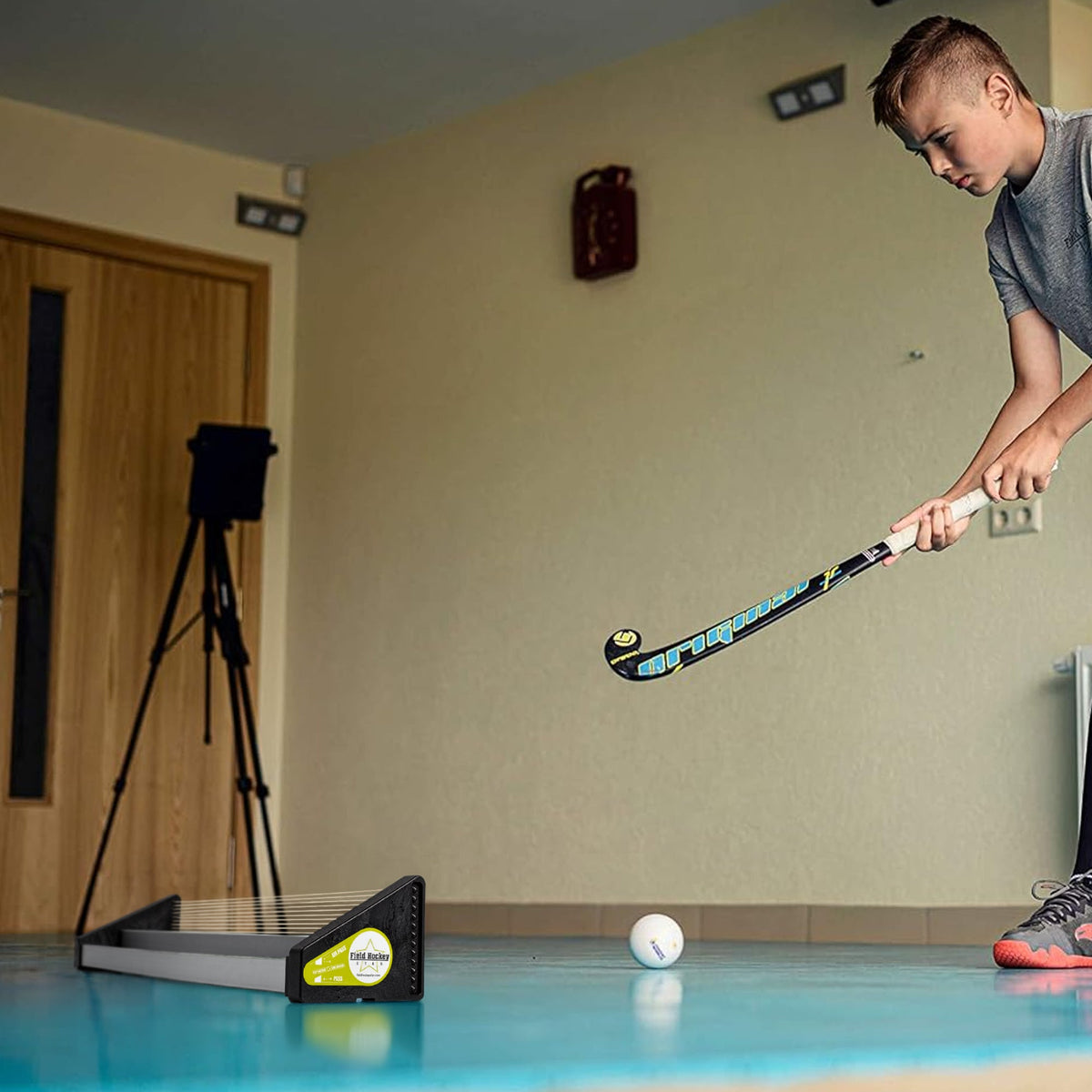
If your child gets hooked, a training aid can make home practice more varied. The Skiller works with the free Field Hockey App for ball control games, and a Rebounder returns passes when there is no suitable wall. Neither is needed in the first season.
Being a good sideline parent
- Cheer effort, not just goals.
- Leave the coaching to the coach during games.
- Ask "What was fun today?" on the drive home, not "Why did you miss?"
- Help with the basics: packed bag, water, on time.
FAQ
Is field hockey a good sport for beginners?
Yes. It builds fitness, coordination and teamwork, and most clubs and programs welcome complete beginners of all ages.
What age can kids start field hockey?
Many clubs start children from about age 5–6 with fun, small-sided sessions. Others start later through school programs.
Is field hockey safe for kids?
With proper shin guards, a mouthguard, any required eye protection and good coaching, it is a safe sport. Young players use adapted rules that limit raised balls and hard hitting.
What size stick does my child need?
A common guide is a stick that reaches around the hip bone when standing upright. Ask the coach to check before you buy.
How can I help my child improve without knowing the sport?
Encourage short, fun practice at home: wall passes, a dribble course with cones, and simple head-up games. Consistency matters more than expertise.
Related articles
- How to help your child get better at field hockey at home
- Field hockey rules explained simply
- What age to start field hockey
In the US? The Rebounder, Skiller and Skills Zone are also available on Amazon.