Quick answer
Most children can start field hockey at around 5–7 years old, in a fun, small-sided format with short sticks and soft rules. Many European clubs run sessions for even younger children, while in the US many players start through town or club programs around 6–10, or in middle school. There is no single "right" age, and starting at 12, 14 or even later still works: players who start late often catch up fast if they practise basic ball control regularly. What matters most is a fun first experience, safe equipment and a coach who keeps things simple.
Key takeaways
- Around 5–7 is a common starting age, but it depends on the child and the local club.
- Late starters are normal, especially in the US where many begin in middle or high school.
- Young beginners should play small-sided games, not full 11-a-side matches.
- Shin guards and a mouthguard are the basic protective gear. Check what your club requires.
- A few minutes of play with a stick and ball at home builds confidence before and between sessions.
Starting ages: Europe vs the US
The path into field hockey looks different depending on where you live:
- Europe: in countries with a strong club culture, such as the Netherlands, Belgium and Germany, children often join a club's youngest group. Training is mostly games and simple skills, and many kids play both outdoor and indoor hockey over the year.
- US: field hockey is often a school sport. Some children start in town recreation or club programs in elementary school, but many first pick up a stick in middle school or at the start of high school. Club and travel teams add more playing time for those who want it.
Ask your local club or school what age groups they run and what the first sessions look like. Age group names and formats vary by country and league.
What to expect at each age
| Age | Focus | Typical format |
|---|---|---|
| 4–6 | Fun, coordination, holding the stick, moving with the ball | Short playful sessions, simple games, no positions |
| 7–9 | Dribbling, push passing, stopping the ball, simple teamwork | Small-sided games on a smaller pitch |
| 10–12 | Reverse stick, receiving on both sides, basic tactics | Larger small-sided games, more structured training |
| 13+ | Hitting, positions, game understanding, fitness | Full-size or near full-size games, school or club teams |
These are rough guides, not rules. A confident 8-year-old and an older beginner may be working on the same skills.
Is my child too old to start?
Almost never. Field hockey skills are learnable at any age. Older beginners usually understand instructions faster and can practise on their own, which helps them catch up. The gap that matters most is ball control, and that improves quickly with regular practice.
For a teenager starting before high school tryouts in the US, a few months of short daily ball control and passing sessions can make a real difference. Be honest with your child: the goal of a first season is to learn and enjoy it, not to be the best player straight away.
How to know your child is ready
- They can follow simple instructions in a group.
- They enjoy running games and using their hands and feet together.
- They are curious about the sport, maybe from watching a sibling or friend.
- They are comfortable with some contact with the ball and the occasional knock on the shin guard.
Equipment for a first season
- Stick: the right length for their height. Ask the club before buying, as many have sticks to try.
- Shin guards and mouthguard: basic protection that most clubs and schools require.
- Shoes: suitable for the pitch surface the club uses.
- Ball: a standard ball, or a softer one for very young children at home.
Help them start at home
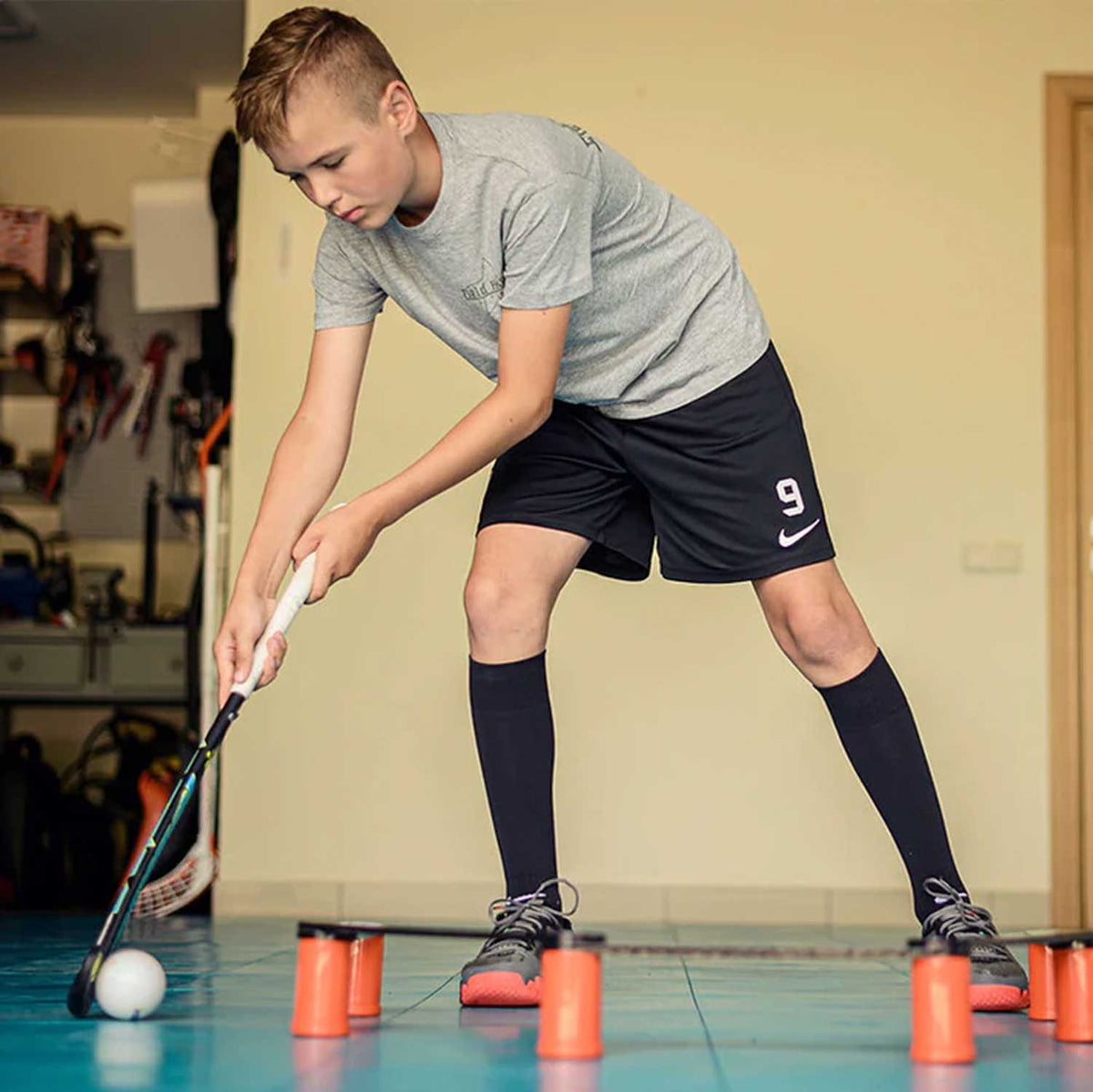
Short, playful sessions of 5–10 minutes at home make a big difference to confidence. Keep the ball on the floor: dribble around cushions, push passes against a wall, games like "how many touches in 30 seconds". For young children, colourful challenges work well. The Skiller is a compact ball control trainer that kids can use with the free Field Hockey App, which calls colours and numbers to react to. A Skills Zone gives them a defined area to dribble in.
Honest note: no training aid is needed to start. A stick, a ball and a parent willing to play are enough. Equipment helps when your child already enjoys practising and wants more variety.
FAQ
What is the best age to start field hockey?
Around 5–7 is common, but there is no single best age. Children can start whenever they are interested and a local club or school has a group for them.
Is 12 or 13 too late to start field hockey?
No. Many players, especially in the US, start in middle school or high school and do well. Regular ball control practice helps late starters catch up.
Can a 4-year-old play field hockey?
Some clubs run playful sessions for very young children. Expect simple games and coordination work rather than real matches. Ask your local club.
What does my child need for their first session?
Usually a stick, shin guards, a mouthguard and suitable shoes. Many clubs lend sticks for the first few sessions, so ask before you buy.
How can I help my child practise at home?
Keep it short and fun: 5–10 minutes of dribbling and push passing with the ball on the floor. Games and challenges work better than drills for young kids.
Related articles
- Field hockey drills for kids (U8–U12)
- Field hockey for beginners: a parent's guide
- How to help your child get better at field hockey at home
In the US? The Rebounder, Skiller and Skills Zone are also available on Amazon.