Quick answer
The best ball control drills for team practice keep every player on a ball at the same time, in a small area, with a clear task. Start with 10 minutes of free dribbling in a grid, then add gates, changes of direction and pressure from a defender. Finish with a small game where good ball control is rewarded. Keep groups small, rest periods short and the number of touches high. A 20–25 minute ball control block, 2–3 times a week, is enough to see clear progress over a season.
Key takeaways
- One ball per player. Queues kill ball control practice.
- Use small grids: about 15 × 15 m (16 × 16 yd) for 8–10 players.
- Move from no pressure, to passive pressure, to real pressure.
- Coach one key point per drill, not five.
- Finish with a game so players use the skill when it matters.
How to set up the session
You need a ball per player, 20–30 cones and a few bibs. Mark one or two grids depending on squad size. Plan the block like this:
| Part | Time | Goal |
|---|---|---|
| Grid dribbling | 5–6 min | Touches, close control, head up |
| Gates | 5–6 min | Change of direction, both sides of the stick |
| Shadow and pressure | 6–8 min | Protect the ball, beat a player |
| Small game | 8–10 min | Use the skill under game pressure |
Drill 1: grid dribbling with calls
All players dribble freely inside a 15 × 15 m (16 × 16 yd) grid. Every 10–15 seconds, call a task:
- "Forehand only", "reverse only", "Indian dribble".
- "Stop": ball stopped dead under the stick within one step.
- "Turn": pull back and go the other way.
- Hold up fingers: players shout the number, which forces them to look up.
Run 3 × 90 seconds with 30 seconds rest. Make the grid smaller each round to add traffic.
Coaching point: ball in front of the body, stick close to the ball, knees bent.
Drill 2: gates
Scatter 8–10 gates (two cones 1 m / 3 ft apart) in the grid. Players dribble through as many gates as possible in 60 seconds. Each gate must be entered on the forehand and exited on the reverse, or the other way round.
- Round 1: count gates, no pressure.
- Round 2: no gate twice in a row.
- Round 3: two players without a ball act as "gate keepers" and try to block gates by standing in them.
Do 4 × 60 seconds with 30 seconds rest. Players track their own best score.
Drill 3: shadow, then pressure
Pairs in a 5 × 10 m (16 × 33 ft) channel. Player A dribbles, player B follows as a shadow defender.
- Phase 1 (passive): B follows one step away and does not tackle. A practises changes of speed and direction. 3 × 30 seconds each.
- Phase 2 (active): B can tackle. A scores by stopping the ball on the end line. 4 attempts each.
Coaching point: keep your body between the defender and the ball. Change speed, not only direction.
Drill 4: small game, "keep it"
4v4 in a 20 × 20 m (22 × 22 yd) area. A team scores one point for 5 passes in a row, and two points if a player beats an opponent with a dribble before passing. This rewards ball control without turning the game into a solo show.
Play 3 × 3 minutes. Rotate teams if you have more than 8 players.
Stations for bigger squads
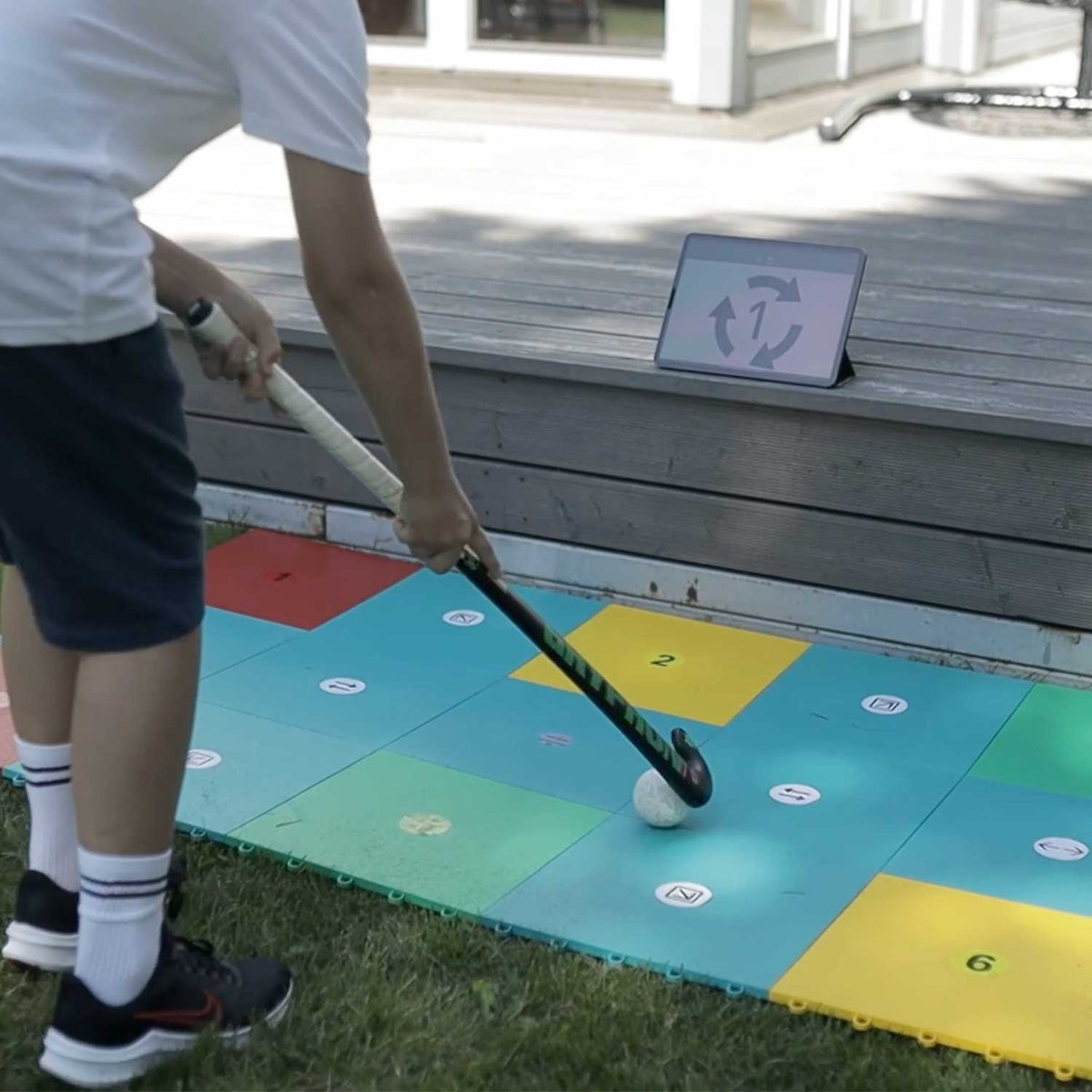
With 16 or more players, split into stations so nobody waits. One station can be grid dribbling, one gates, one passing against a wall or Rebounder, and one reaction work on a Skiller where players follow colour calls from a teammate or the Field Hockey App. Rotate every 5–6 minutes.
Honest note: you don't need any of these tools for team practice. Cones, balls and a clear plan do most of the work. Training aids are useful for a self-running station while you coach another group.
Common coaching mistakes
- Too many players per ball. If players stand in lines, change the drill.
- Grids that are too big. Big space means less pressure and fewer decisions.
- No progression. Once a drill looks easy, add a defender, a time limit or a smaller area.
- Only forehand. Make the reverse stick part of every drill.
Adjust for age and level
- U8–U10: keep it playful, use names like "traffic lights" and short rounds of 45 seconds.
- U12–U14: add scoring, counting and passive defenders.
- High school and adult: add full pressure, smaller grids and decisions after the dribble.
In the indoor season, the same drills work well in a sports hall. Shrink the grids and keep the ball on the floor.
FAQ
How long should ball control drills last in team practice?
About 20–25 minutes is a good block. Split it into 3–4 short drills and finish with a game.
How many players per grid?
About 8–10 players in a 15 × 15 m (16 × 16 yd) grid. With more players, make two grids so everyone has space and touches.
How do I make players look up while dribbling?
Hold up fingers or colours and have players call them out. Add traffic in the grid so they must look up to avoid collisions.
Should beginners use pressure drills?
Start without pressure, then add a passive defender who only follows. Move to real tackles once players can keep the ball close.
Do I need special equipment?
No. Balls, cones and bibs are enough. Training aids help when you want a station that runs without a coach.
Related articles
- How to coach ball control to beginners
- Station-based training: 4 stations, one coach
- Small-sided games for field hockey
In the US? The Rebounder, Skiller and Skills Zone are also available on Amazon.