Quick answer
Station-based training splits your squad into four small groups that rotate through four drills at the same time. With one coach, three stations must run on their own and one station is "coached". Use simple, repeatable drills with clear scoring at the self-run stations, and put the skill that needs your eye at the coached station. Rotate every 6–8 minutes, so a full circuit takes about 30 minutes. Every player gets far more touches than in a single line drill.
Key takeaways
- One coached station, three self-running stations. Never four drills that all need you.
- Each self-run station needs a clear task, a score and a reset rule players can follow without you.
- Groups of 3–5 players keep everyone busy. More than that, and players start waiting in line.
- Use a whistle and a fixed rotation direction. Changeovers should take under 30 seconds.
- Cones, a wall and balls are enough. Training aids help when you have them.
Why stations work
A typical drill with one line of 16 players gives each player a handful of touches. Four stations of four players multiply that. Stations also let you mix skills in one block: ball control, passing, footwork and shooting, without long explanations between each one. For clubs with one volunteer coach, they are the most efficient way to run a session.
Setting up the area
Divide half a pitch or a sports hall into four zones of roughly 10 × 15 m (33 × 50 ft). Number them 1 to 4 and always rotate in the same direction. Put the coached station where you can still see the other three.
- Explain all four stations once, before the first rotation, with a quick demonstration.
- Give each group a captain who restarts the drill and keeps score.
- Have a bucket of balls at every station, so no one leaves to collect them.
A sample 4-station circuit
| Station | Focus | Task | Score |
|---|---|---|---|
| 1 (coached) | Receiving and passing | Receive on the reverse stick, move to forehand, pass to a gate 8 m (26 ft) away | Coach gives feedback, no score |
| 2 | Ball control | Slalom through 6 cones 1 m (3 ft) apart with Indian dribble, there and back | Number of clean runs in 2 minutes |
| 3 | Footwork and reaction | Dribble into a 4-cone square; partner calls a colour, player dribbles to that cone | Correct calls in 60 seconds |
| 4 | Shooting accuracy | Push or hit at targets in the goal from the top of the circle | Targets hit out of 10 |
Rotate every 7 minutes with 30 seconds to change. Four stations take about 30 minutes.
Making the self-run stations work
Station 2: ball control
Keep it simple: dribble, turn, come back, next player goes. Players count their own clean runs (no cone touched). A Skiller is a good alternative to cones: it gives players a fixed obstacle to dribble through and adds colour and number calls with the free Field Hockey App.
Station 3: footwork and reaction
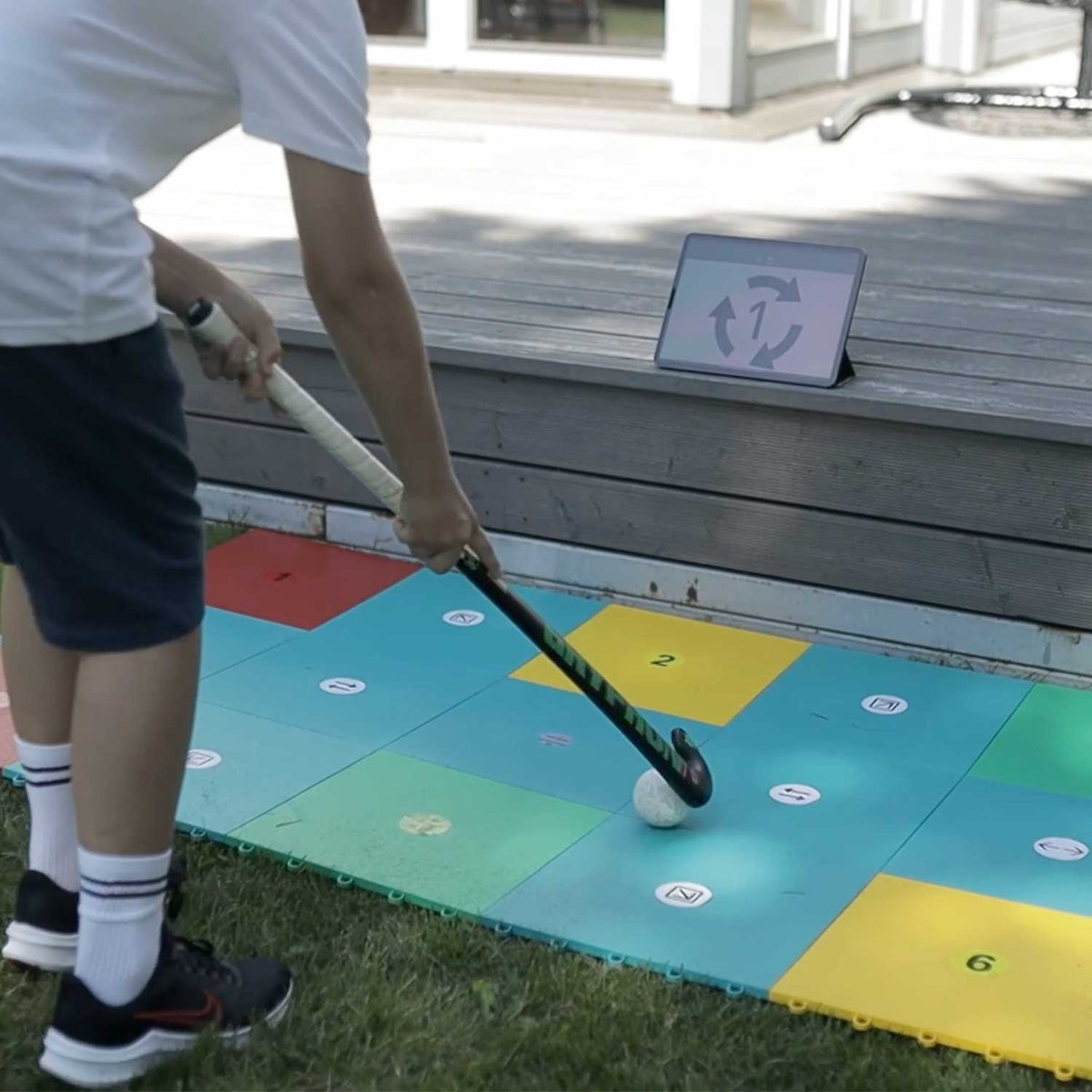
Players take turns as the caller. If you have one, a Skills Zone 360 (25 tiles with symbols, 165 × 165 cm / 65 × 65 in) gives a ready-made pattern area, and the app can do the calling. Cones in coloured pairs do the same job.
Station 4: shooting
Hitting needs supervision. If this station is far from you, make it push shots only, or swap it with a passing drill. A Goal Target (six 42 × 42 cm targets that attach to the goal) gives a clear score without a goalkeeper. Make sure no one stands near the goal or retrieves balls while others shoot.
An extra passing option
If you have a wall, a pair of players can do timed passing against it. A Rebounder works the same way where there is no wall, for example on an open pitch.
Your job at the coached station
- Teach one coaching point per group, not five.
- Look up every minute to check the other stations.
- Give the same point to each group, so the whole squad hears it by the end.
- Note one player per group who needs extra help next session.
Common problems and fixes
- Groups finish early: add a challenge, like "beat your score" or "reverse stick only".
- Lines forming: split the station into two halves with their own cones.
- Messy changeovers: one whistle to stop, a second to start, always the same direction.
- Young players lose focus: shorten stations to 4–5 minutes for U10 and below.
Honest notes
Stations build technique and touches, but they don't teach game decisions. Finish every session with a small-sided game so players use the skills under pressure. And you don't need equipment to start: cones, balls and a wall run a great circuit.
FAQ
How long should each station last?
6–8 minutes works for most teens and adults. For younger players, 4–5 minutes keeps attention high.
How many players per station?
3–5 players. With more, split a station into two mirrored halves.
Can one coach really run four stations?
Yes, if three stations are simple, scored and self-running, and you stay at the fourth station where you can see everything.
Is station training good for warm-ups?
Yes. A short circuit of easy ball work and footwork is a good warm-up, followed by a proper dynamic warm-up before hitting or sprinting.
Related articles
- Field hockey practice plan template (60 and 90 minutes)
- Small-sided games for field hockey
- Warm-up drills for field hockey practice
In the US? The Rebounder, Skiller and Skills Zone are also available on Amazon.