
Quick answer
To coach ball control to beginners, start with grip and stance, then teach one skill at a time in this order: open-stick dribbling, the Indian dribble, the pull-back, and simple direction changes. Give every player a ball, keep explanations under 30 seconds, and spend most of the session with the ball moving. Use short blocks of 2–4 minutes, add head-up challenges early, and finish with a small game where the new skill earns points. Correct one thing at a time and praise specific improvements.
Key takeaways
- One ball per player. Waiting in line is the biggest waste of time in beginner sessions.
- Teach grip and a low, balanced stance before any moves.
- Progress from slow and static to moving, then to pressure and games.
- Introduce head-up dribbling early so it never becomes a late fix.
- Keep instruction short: show, try, give one cue, try again.
The foundations: grip and stance
Most beginner ball control problems come from grip and posture, not from the moves themselves. Check these before anything else:
- Left hand at the top of the stick, controlling the rotation. The right hand sits lower on the handle and stays relaxed so the stick can turn inside it.
- Hands apart, roughly a hand's width or a bit more, for control.
- Knees bent, back fairly flat, eyes forward. The ball sits slightly in front and to the right of the feet.
- Flat side only. Remind players that the ball may only be played with the flat side of the stick, including the edges.
Coaching cue: "Left hand turns, right hand guides."
A progression for beginners
| Stage | Skill | Success looks like |
|---|---|---|
| 1 | Open-stick dribble in a straight line | Ball stays within one stick length, player keeps a steady jog |
| 2 | Indian dribble on the spot | 10 clean side-to-side touches without losing the ball |
| 3 | Indian dribble while walking, then jogging | Covers 10 m (33 ft) with control |
| 4 | Pull-back and change direction | Stops the ball, turns, and accelerates away |
| 5 | Head-up dribbling | Reacts to a coach's signal while keeping the ball |
| 6 | Dribbling under light pressure | Protects the ball from a passive defender |
Don't rush through stages. Some groups need two or three sessions on stages 1–3.
Five drills for a 30-minute ball control block
1. Grid dribble (5 minutes)
Mark a 15 × 15 m (50 × 50 ft) square. Every player dribbles freely inside it. On "change", they turn and go another way. On "stop", they freeze with the ball on their stick. This teaches control in traffic without any waiting.
2. Indian dribble ladder (5 minutes)
Players stand still and do the Indian dribble for 20 seconds, rest 10 seconds, and repeat 6 times. Progress: narrow then wide, slow then fast, then moving forward 5 m (16 ft) and back.
3. Cone gates (6 minutes)
Set up 10–12 gates made from two cones 1 m (3 ft) apart around the area. Players dribble through as many gates as possible in 60 seconds. Rest 30 seconds, repeat 4 times and try to beat the score.
4. Traffic lights (6 minutes)
The coach holds up coloured cones or bibs. Green means dribble fast, yellow means slow with the Indian dribble, red means pull-back and stop. Players must look up to see the colour, which builds head-up habits from day one.
5. Pirates game (8 minutes)
Everyone has a ball in a 20 × 20 m (65 × 65 ft) area except two "pirates". Pirates try to tap balls out of the square. Players who lose their ball become pirates. Play 3 rounds of 2 minutes. Keep it to taps and steals, no hitting.
How to give feedback
- One cue at a time. "Bend your knees" is enough. Don't add three more corrections.
- Show, don't lecture. A 10-second demonstration beats a 2-minute explanation.
- Praise specifically: "Great, your left hand turned the stick there."
- Freeze the group rarely. Coach individuals while everyone keeps moving.
Equipment for beginner sessions
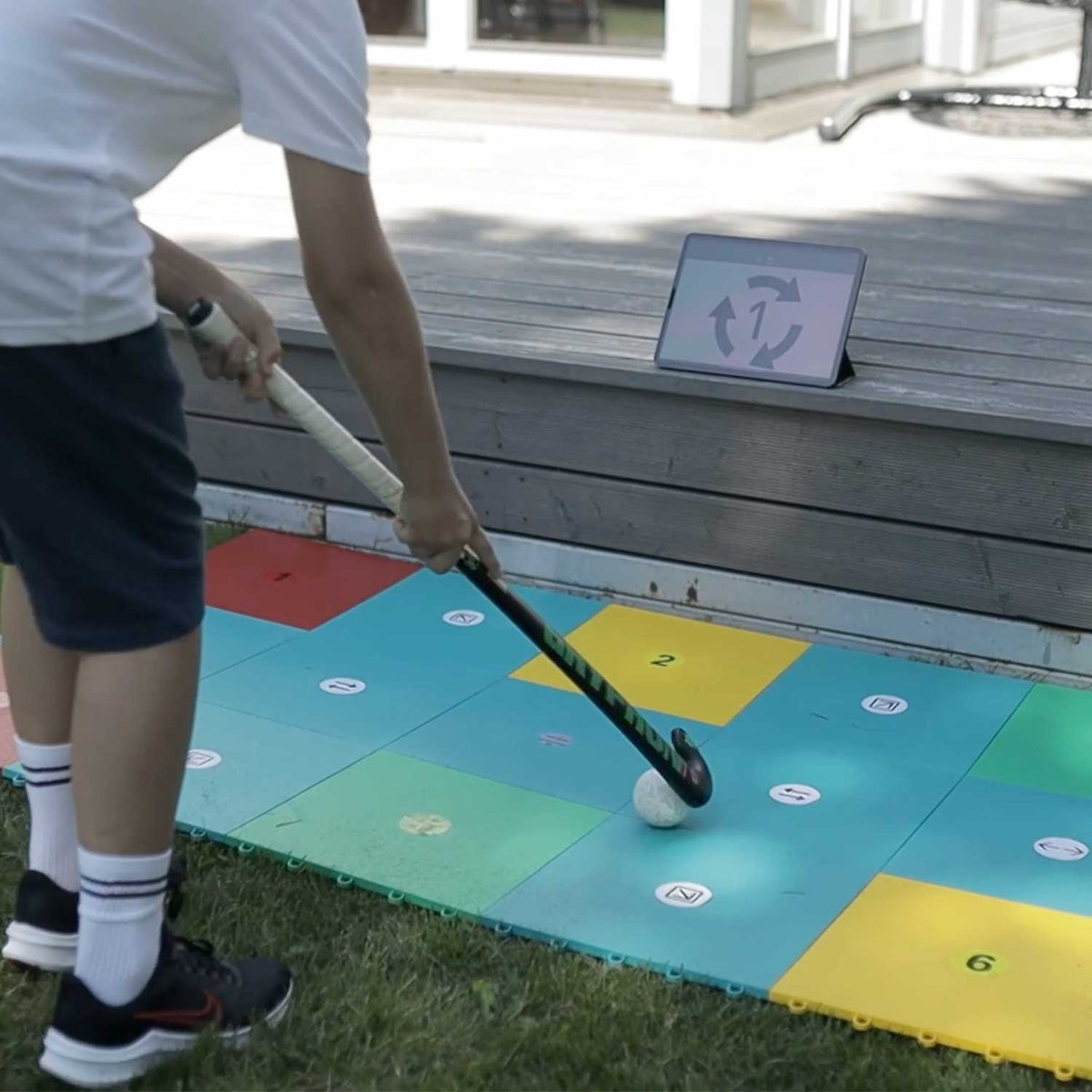
You need balls (ideally one each), cones and bibs. That covers most sessions. Training aids can add variety for stations or small groups: a Skiller works well as a ball control station with colours and numbers, and Skills Zone tiles give players a defined area for footwork and dribbling patterns. They are useful extras, not requirements. For more ideas, see the ball control collection.
Common mistakes coaches make
- Long lines with one ball per group.
- Teaching advanced 3D skills before players can do a clean Indian dribble.
- Skipping games. Beginners need to see why the skill matters.
- Correcting everyone the same way. Some players need grip help, others need posture help.
FAQ
What is the first ball control skill to teach in field hockey?
Start with grip, stance and simple open-stick dribbling in a straight line. Once players can move with the ball under control, introduce the Indian dribble.
How long should a beginner ball control session be?
For young beginners, 20–30 minutes of ball control inside a 60-minute practice is plenty. Use short blocks of 2–5 minutes and change activity often.
When should beginners learn the reverse stick?
Introduce reverse stick touches as part of the Indian dribble from the start. Reverse stick receiving and dribbling can follow once the basic grip is secure.
How do I stop beginners from looking down at the ball?
Add head-up challenges early, like colour calls and traffic lights. Players will still glance down, which is normal. The goal is quick glances, not staring.
Can beginners practise ball control at home?
Yes. A flat floor of about 2 × 3 m (6.5 × 10 ft), a ball and a few cones are enough for 10–15 minutes of dribbling a few times a week.
Related articles
- Station-based training: 4 stations with one coach
- Ball control drills for team practice
- Indian dribble: step-by-step guide and drills
In the US? The Rebounder, Skiller and Skills Zone are also available on Amazon.

