Quick answer
To protect the ball under pressure in field hockey, keep it moving, keep it on the side away from the defender, and keep it close to your stick. Look up before you receive so you already know where the pressure is coming from, then receive on the move into free space. Change speed or direction to pull the ball out of the tackle, and pass early when you are closed down. You cannot simply stand still and put your body between the ball and a defender: that is obstruction. Protection comes from ball position, footwork and decisions, not from blocking.
Key takeaways
- Scan before you receive. Most turnovers start with a player who did not know the defender was there.
- Keep the ball on your open side, away from the defender's stick, and within easy reach of your own.
- Keep moving. A stationary ball is easy to tackle and easy to be penalised over.
- Change pace and direction to take the ball away from the tackle, then accelerate.
- Passing early is also protecting the ball.
Protecting the ball vs obstruction
This is the part many players, and some parents, get wrong. In field hockey you may move off with the ball in any direction, but you may not move your body into an opponent, or into a position between the ball and an opponent who is close enough to play it and trying to. Standing still and backing into a defender to keep them away is obstruction, and the umpire will give a free hit or, in the circle, a penalty corner against you.
Interpretation differs between levels and umpires, so check your league's rules and listen to how your umpires call it. The safe habit is simple: if the defender is close and wants the ball, you move the ball and yourself, you do not freeze.
The four habits that keep the ball
1. Scan before the ball arrives
Take a look over each shoulder before the pass reaches you. You want two answers: where is the nearest defender, and where is the space? Then your first touch can go away from pressure instead of into it.
2. Ball position: open side, close to the stick
Keep the ball slightly in front of you and on the side furthest from the defender. If they come from your left, carry it on your right with an open stick. If they come from your right, you may need to move the ball across or use the reverse stick. Hands apart, knees bent and the stick low give you control in both directions.
3. Change speed and direction
Defenders tackle where the ball is going to be. A sudden slow-down, a pull-back or a drag to the other side makes their tackle arrive at empty space. Then accelerate away.
4. Release early
When two defenders close you down, the best protection is a pass. Look for the free teammate as soon as you feel the second defender coming. Under pressure, a simple push pass is safer than a dribble.
Drills
Solo: close control with head up (10 minutes)
Set out 5 cones in a line, 1 m (3 ft) apart, or use a Skiller. Dribble through with small touches, eyes up as much as possible.
- 4 × 1 minute: forehand side only, keeping the ball within 30 cm (1 ft) of the stick.
- 4 × 1 minute: alternate forehand and reverse stick on every cone.
- Rest 30 seconds between sets.
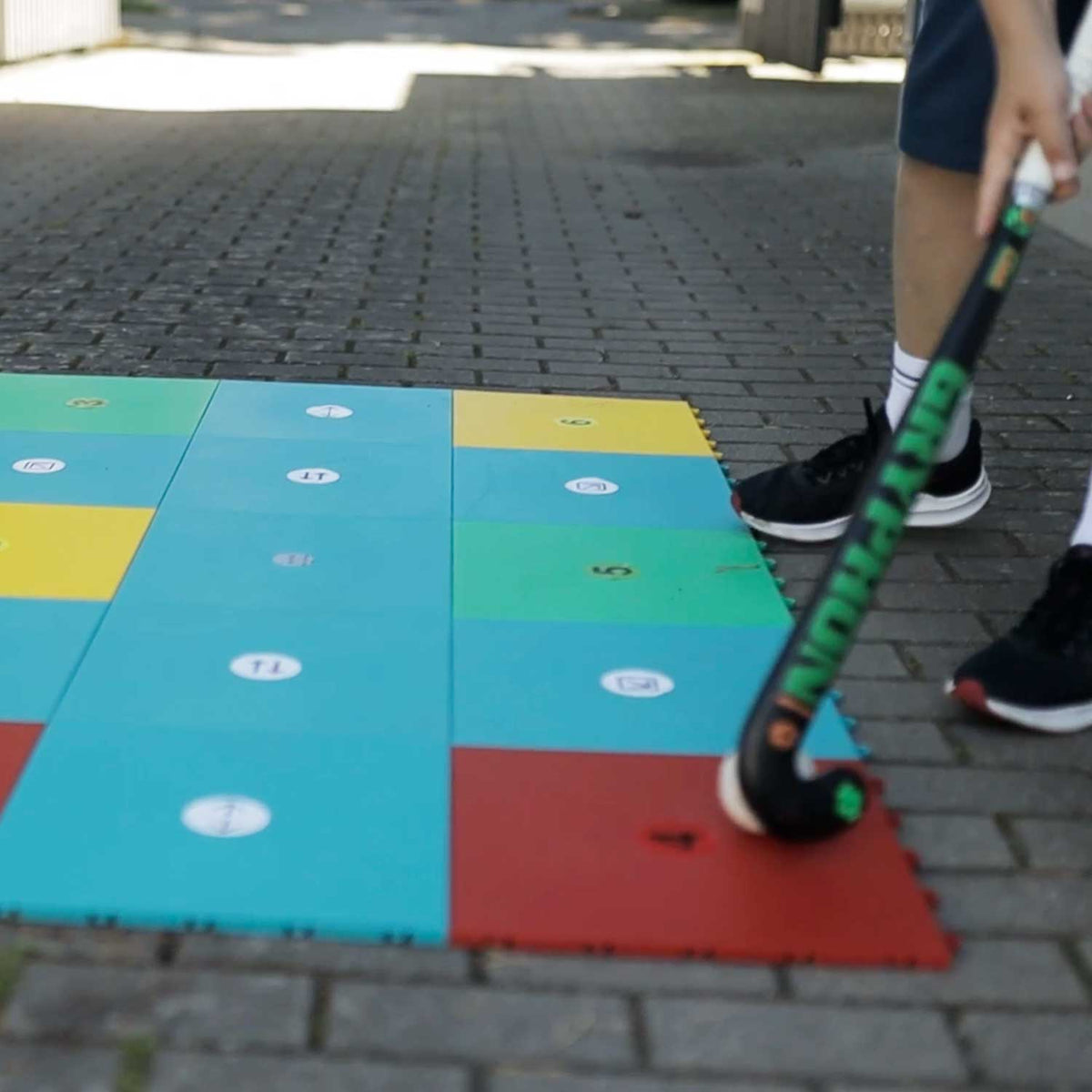
With the free Field Hockey App, the Skiller calls colours and numbers, so you have to look up and react, which is exactly what happens when a defender appears.
Solo: shadow defender (5 minutes)
Place one cone as an imaginary defender. Dribble towards it at medium speed. About 2 m (6–7 ft) away, pull the ball away to the side the "defender" is not covering, then accelerate for 3 m (10 ft). Do 10 reps to each side. Keep the ball moving the whole time.
Partner: keep-ball box (10 minutes)
Mark a box of 5 × 5 m (16 × 16 ft). One attacker, one defender. The attacker tries to keep the ball for 20 seconds inside the box, moving it, turning and changing speed. The defender may only try to tackle the ball fairly. Swap roles each round, 6 rounds each. No hitting, no lifting, and stop the round if either player uses their body to block.
Small group: 2v1 release (on the pitch)
Two attackers against one defender in a 10 × 15 m (33 × 49 ft) channel. The ball carrier must keep possession until the defender commits, then pass to the free player. This teaches the timing of the release, not just the dribble.
Common mistakes
| Mistake | What happens | Fix |
|---|---|---|
| Receiving flat-footed | Defender steps in before the first touch | Move towards space as the ball arrives |
| Ball too far from the stick | Easy jab tackle | Smaller touches, lower body |
| Backing into the defender | Obstruction call | Turn away or pass instead of freezing |
| Eyes on the ball only | Runs into a second defender | Head-up drills, scan before receiving |
Train at home, test on the pitch
At home you build the close control and the head-up habit. A smooth hard floor or a set of Flooring Tiles works well. A Skills Zone 360 adds quick footwork in all directions. Honest note: none of these tools can press you like a real defender. You still need partner and team drills to learn timing under contact. Cones and a wall are enough to start.
FAQ
Is shielding the ball allowed in field hockey?
Not in the way it is in some other sports. You may move with the ball, but you may not put your body between the ball and an opponent who is trying to play it. That is obstruction. Check your league's rules and how your umpires interpret it.
Which side should I keep the ball on when pressed?
The side furthest from the defender, close to your stick. Most players are strongest on the open side, so practise the reverse stick too, or defenders will learn to force you onto it.
How do I stop panicking when a defender closes in?
Scan before you receive so the pressure is not a surprise, and decide your escape option early: turn, drag away or pass. Repetition in small boxes makes the reaction automatic.
Can I practise ball protection alone at home?
Partly. You can train close control, head-up dribbling and quick changes of direction alone. Learning to deal with real pressure needs a partner or team practice.
When should I pass instead of dribbling?
When a second defender is closing, when a teammate is free in a better position, or when you are deep in your own half. Keeping the ball for the team matters more than beating a player.
Related articles
- Elimination skills: how to beat a defender 1v1
- Head-up dribbling: drills to stop looking at the ball
- How to do a pull-back in field hockey
In the US? The Rebounder, Skiller and Skills Zone are also available on Amazon.