
Quick answer
To stop looking at the ball while dribbling, you need two things: a very controlled ball position, and drills that force your eyes up. Keep the ball in front of your body and close to the stick, so you can feel it and see it at the bottom of your vision. Then train with a task that happens above the ball: calling out numbers, colours or symbols, or scanning for a target. Start slowly, about 3 sessions a week of 10–15 minutes, and speed up only when you can keep the ball close. Give it 4–6 weeks before you judge the results.
Key takeaways
- You don't stop seeing the ball. You see it at the bottom of your vision while you look ahead.
- Ball position comes first: in front of you, slightly to the right, close to the stick.
- Give your eyes a job: numbers, colours, symbols or a target to find.
- Go slow first. Speed without control just builds the old habit again.
- Use quick glances: look up, glance down, look up again.
Why players look down
Most players look at the ball because they don't trust their touch yet. The ball drifts too far from the stick or too close to the feet, and the only way to fix it is to look. So the first step is not "look up", it is "keep the ball where you can feel it". When the ball is in a consistent spot, your eyes can leave it.
The second reason is habit. If every drill you do is a fixed cone route, there is nothing to look up for. Game-like drills give your eyes a reason to scan.
The right body and ball position
- Body: knees bent, back fairly straight, chest up rather than folded over the ball.
- Ball: about an arm's length in front, slightly right of centre for forehand dribbling.
- Stick: left hand at the top doing most of the turning, right hand loose lower down.
- Eyes: looking 5–10 m (16–33 ft) ahead, with the ball at the bottom of your view.
Five head-up drills
1. Number calls
Dribble on the spot or in a small area. A partner stands 5 m (16 ft) away and holds up fingers every 2–3 seconds. Call the number out loud. 4 × 45 seconds, 20 seconds rest. If you miss a number or lose the ball, slow down.
2. Colour and symbol reaction
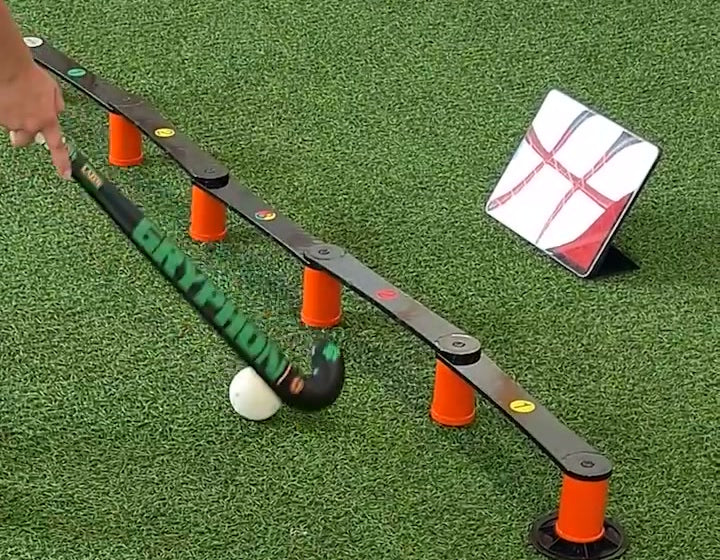
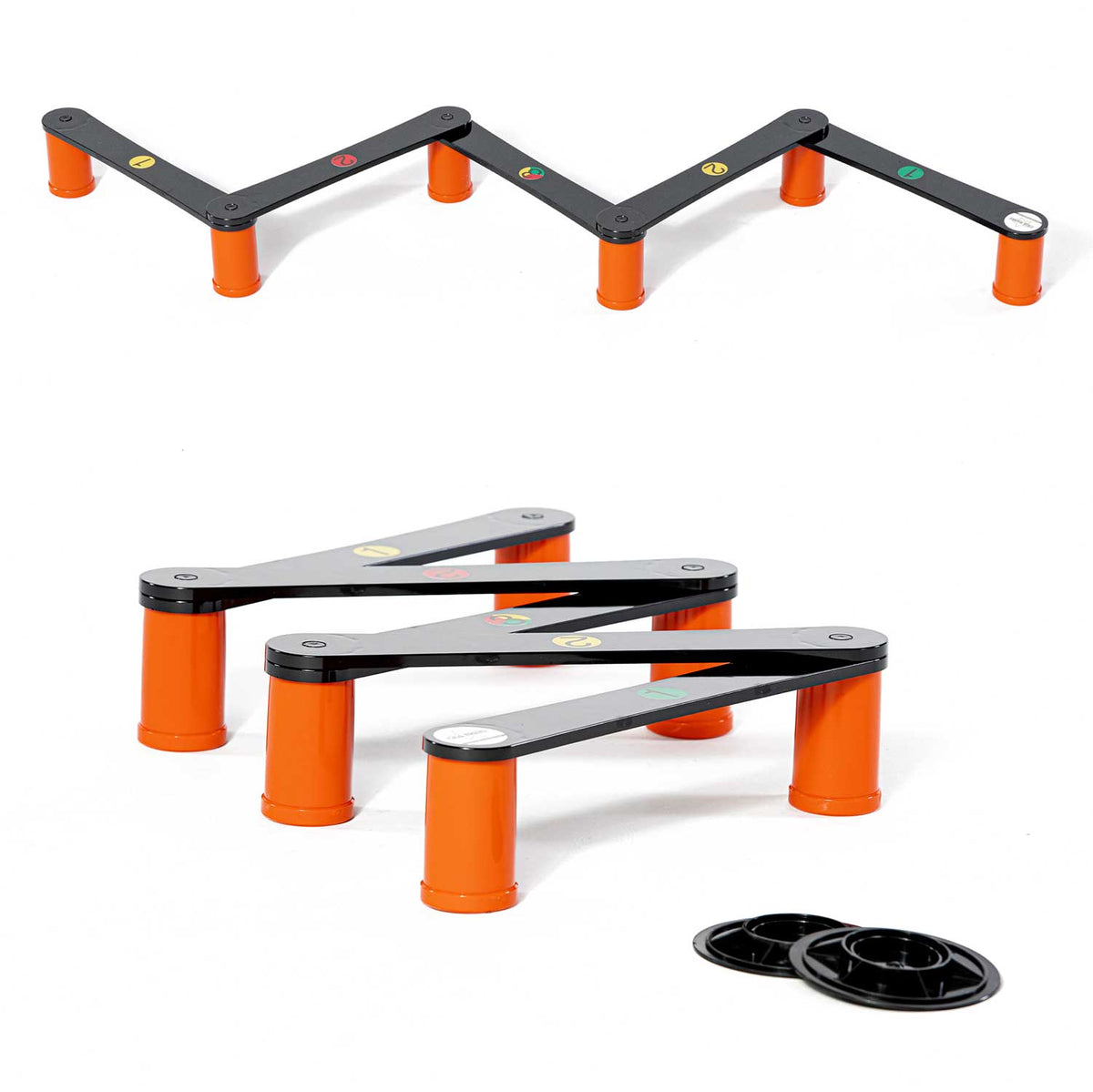
Use cones in four colours, or Skills Zone tiles with colours and symbols. A partner or the free Field Hockey App calls a target. Dribble to it, stop the ball, and wait for the next call. Because the call comes from outside, you have to keep your eyes up. 5 × 40 seconds.
3. Skiller with app calls
The Skiller has colours and numbers and works with the app. Dribble around it while the app calls colours or numbers, and touch the ball toward the called spot. It's a compact way to train head-up control in a small room. Honest limit: it's one fixed spot, so combine it with dribbling over a longer distance on the pitch.
4. Mirror dribble
Two players face each other 3 m (10 ft) apart, each with a ball. One leads, moving left, right, forward and back. The other mirrors. You can only copy the movement if you watch your partner, not your ball. 3 × 45 seconds each as leader.
5. Scan and pass
Dribble toward a wall or Rebounder from 8 m (26 ft). A partner calls "left" or "right" at a random moment. Move the ball to that side and push pass. 3 sets of 6 passes. On the pitch, swap the call for a teammate who moves into space.

A 4-week progression
| Week | Focus | Speed |
|---|---|---|
| 1 | Ball position, number calls on the spot | Slow |
| 2 | Colour and symbol calls, short dribbles | Slow to medium |
| 3 | Mirror dribble, scan and pass | Medium |
| 4 | All drills with a passive defender or at game speed | Fast |
Test yourself at the start and end: count how many partner calls you get right in 60 seconds without losing the ball.
Common mistakes
- Ball too close to the feet: you have to look down to avoid kicking it.
- Head up, but body folded: bend the knees, not the back.
- Going too fast too soon: slow, clean reps build the habit.
- Only the forehand: head-up dribbling on the reverse stick needs training too.
FAQ
How do I stop looking at the ball when dribbling in field hockey?
Keep the ball in a consistent spot in front of you, then train with tasks that make you look up, like calling numbers or reacting to colours.
Should I never look at the ball?
No. Quick glances are normal, especially when receiving or before a pass. The goal is to look up most of the time and glance down briefly.
How long does it take to learn head-up dribbling?
With 3 short sessions a week, many players notice a clear difference in 4–6 weeks. It keeps improving with game practice.
Can I train head-up dribbling alone?
Yes. Use an app that calls colours or numbers, or put targets on a wall to find while you dribble.
Can I do these drills indoors?
Yes, on a flat floor. Keep the ball on the ground and use push passes only, no hitting.
Related articles
- How to improve ball control in field hockey
- Reaction-time drills for field hockey players
- Indian dribble: step-by-step guide and drills
In the US? The Rebounder, Skiller and Skills Zone are also available on Amazon.