Quick answer
To beat a defender 1v1 in field hockey, attack at speed, get the defender to commit, then change direction or pace just outside their stick reach. The most useful elimination skills are the change of pace, the pull-right and pull-left, the V-drag, the reverse stick pull and the spin. Keep the ball close and away from the defender's stick, and accelerate hard after the move. Practise each move slowly against a cone, then at speed, then against a live defender. At home you can drill the moves; real timing comes from 1v1 practice.
Key takeaways
- Elimination is about timing and distance, not just fancy moves.
- Make the defender commit first, then move the ball past their stick.
- Change of pace is the simplest and most effective elimination.
- Accelerate for 3–5 m (10–16 ft) after the move, or the defender recovers.
- Learn two or three moves well instead of ten moves badly.
The principles of beating a defender
- Attack the defender. Dribble straight at them, or at their stick side, to make them commit.
- Read the distance. Make your move when the defender is about 1.5–2 m (5–6.5 ft) away, just outside their tackling reach. Too early and they adjust; too late and they tackle.
- Move the ball away from the stick. Take the ball to the side where the defender's stick is not.
- Explode. The move creates half a metre of space. Your acceleration turns it into a real advantage.
- Protect the ball. Keep your body between the defender and the ball when you can, without obstructing. Shielding the ball by turning your back to block a defender who is trying to play it is a foul.
Five elimination skills to learn
1. Change of pace
Dribble at the defender at medium speed. When they start to match your speed, slow down slightly, then explode past them. No fancy stickwork needed. Most good players use this more than any other move.
2. Pull-right (open side)
Dribble at the defender, then pull the ball quickly to your right with the forehand and accelerate past their left side. Keep the ball in front of you, not behind your feet.
3. Pull-left (reverse stick pull)
Turn the stick over and pull the ball across your body to the left with the reverse stick, then go. This takes the ball to the defender's forehand side, so it has to be quick and well-timed.
4. V-drag
Drag the ball back toward you and then push it out at an angle, making a V shape. The drag pulls the defender in; the second movement takes the ball around them. It is a great move when the defender is flat-footed.
5. Spin (with care)
Turn away from the defender and spin out on the other side. Useful near the sideline or when the defender is very close. Make sure you are moving the ball, not just turning your back to block, which would be obstruction.
Practice progression
| Step | Setup | Goal |
|---|---|---|
| 1. Static | One cone as a defender, walk the move | Correct stick and ball path |
| 2. Speed | Same cone, approach at a jog then run | Clean move without slowing down |
| 3. Decision | Two cones, partner calls left or right late | Choose the side quickly |
| 4. Passive defender | Partner defends at half pace | Read real distance |
| 5. Live 1v1 | Full pressure in a 10 × 15 m (33 × 50 ft) channel | Beat the defender and finish |
Three home drills
Cone defender (6 minutes)
Place a cone 8 m (26 ft) away and a second cone 3 m (10 ft) past it as a finish line. Dribble at the first cone, make your move at about 1.5 m (5 ft), then sprint to the finish. Do 5 reps of each move on each side.
Call-the-side (5 minutes)
Set two cones side by side 1 m (3 ft) apart. A partner calls "left" or "right" as you arrive, or you use the free Field Hockey App for random calls. Eliminate to the called side. This trains late decisions. 4 sets of 60 seconds.
Tight-space control (5 minutes)
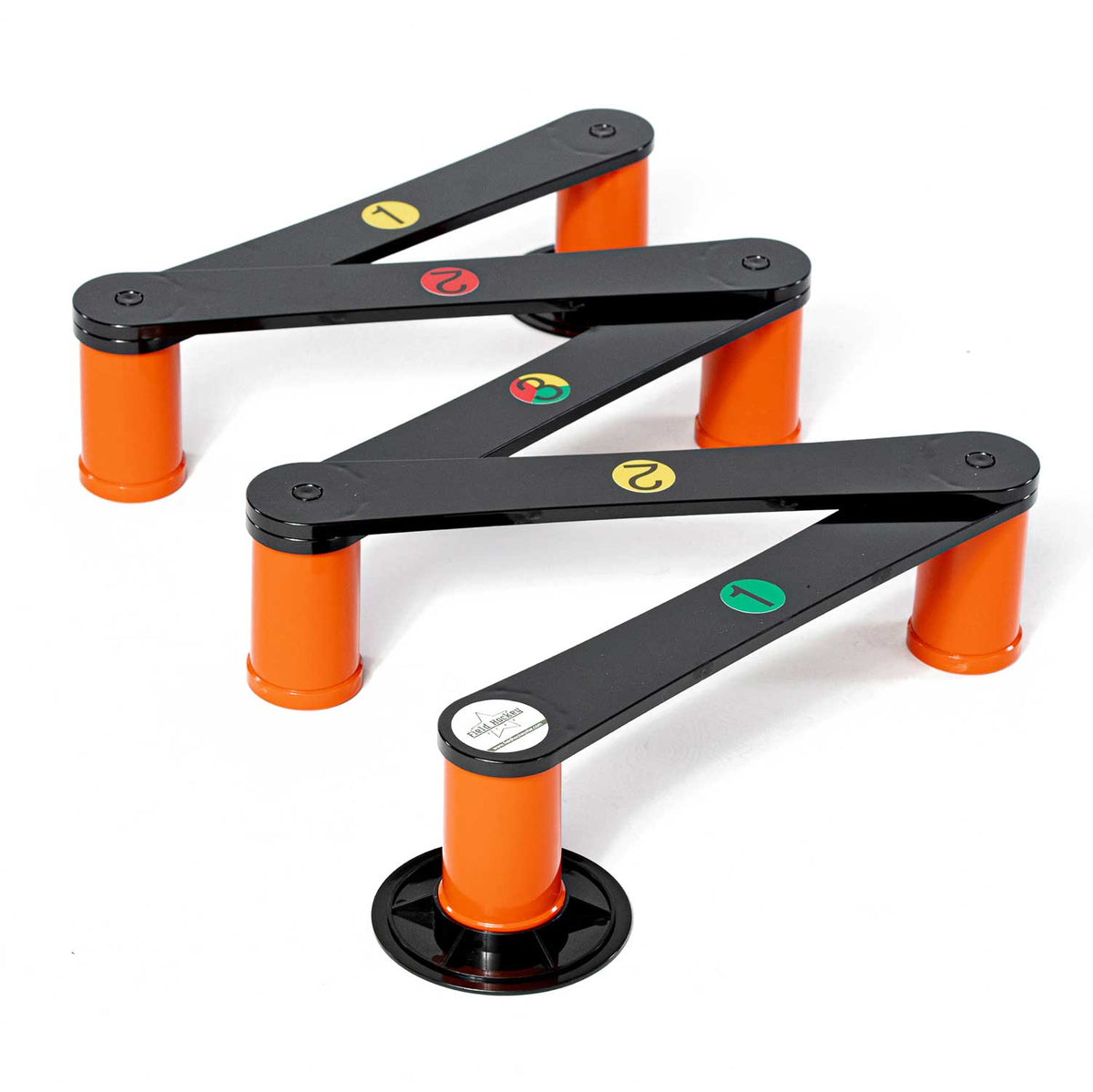
Elimination needs very close control. Work through a Skiller or a tight cone grid with quick pulls and drags, keeping the ball within a stick length. The Skiller is useful for close control, but it can't react like a real defender, so pair it with live 1v1 practice. Skills Zone tiles help with footwork and changes of direction in a small space.
Common mistakes
- Moving too early. The defender just adjusts. Get closer before you go.
- No acceleration. A great move followed by a jog lets the defender recover.
- Ball too far from the stick. Defenders win loose balls.
- Always going the same way. Defenders learn your favourite side quickly.
- Looking only at the ball. Glance up to read the defender's feet and stick.
FAQ
What is the easiest elimination skill in field hockey?
The change of pace. Slow down to make the defender slow down, then accelerate past them. It needs no complex stickwork and works at every level.
When should I make my move against a defender?
Usually when the defender is about 1.5–2 m (5–6.5 ft) away, just outside their reach. Practise reading this distance in live 1v1s.
Is turning my back to the defender allowed?
Spinning while moving the ball is fine. Using your body to block a defender who is trying to play the ball is obstruction and gives away a free hit.
Can I practise elimination skills at home?
Yes, you can practise the moves with cones, tight-control drills and footwork. The timing against a real defender comes from 1v1 practice at training.
How many elimination moves should I learn?
Two or three moves you can do at full speed on both sides are worth more than many moves you can only do slowly.
Related articles
In the US? The Rebounder, Skiller and Skills Zone are also available on Amazon.