Quick answer
Beginners should learn dribbling in this order: the correct grip and ready position, the open-side (forehand) dribble, then the Indian dribble, and finally simple changes of direction like the pull-back. Practise each skill slowly first, with the ball out in front of your feet, then add speed, cones and head-up work. Five simple drills done 10–15 minutes a day, 3–4 times a week, will make a clear difference within a month. All of them are ground skills, so you can do them safely at home.
Key takeaways
- Get the grip right first: left hand at the top, right hand lower down.
- Keep the ball out in front and slightly to the right, not under your feet.
- Slow and clean beats fast and messy. Speed comes later.
- Look up between touches as early as you can.
- Short, frequent practice works better than one long session.
The basics before you dribble
Grip
Left hand at the top of the stick, as if shaking hands with it. Right hand lower down the grip, about a hand's width or more below. The left hand turns the stick; the right hand supports it. Everyone uses this grip: field hockey sticks are made for right-hand-side play, whether you are left- or right-handed.
Ready position
- Feet about shoulder width apart, knees bent.
- Back fairly flat, leaning forward a little.
- Ball out in front of your right foot, about an arm's length away.
- Eyes up as much as possible, glancing down at the ball.
Five beginner dribbling drills
Drill 1: Open-side dribble in a line (3 × 1 minute)
Dribble forward over 10 m (33 ft) with the ball on your forehand side, using small taps. The ball should stay within a stick length. Walk the first set, jog the second and third. At the end, stop the ball, turn and come back.
Coaching point: keep the ball slightly to the right and in front, so you can see it and the space ahead at the same time.
Drill 2: Indian dribble on the spot (4 × 30 seconds)
Move the ball from right to left and back by turning the stick. On the right, the flat side pushes the ball left. On the left, turn the stick over (reverse stick) and push it back right. Turn the stick with the left hand while the right hand stays loose.
Start wide and slow, about 60 cm (2 ft) side to side. As you improve, make it faster and narrower.
Drill 3: Cone slalom (4 × 45 seconds)
Place 5 cones in a line, 1.5 m (5 ft) apart. Dribble through them using the Indian dribble, keeping the ball close. Turn at the end and come back. When it gets easy, move the cones to 1 m (3 ft) apart.
Drill 4: Stop and go (3 × 1 minute)
Dribble forward. Every 3–4 m (10–13 ft), stop the ball dead with the stick, then accelerate away. Then try a pull-back instead of a stop: pull the ball back towards you, then push forward again. This teaches you to control the ball when you change speed, which defenders find hard to read.
Drill 5: Heads-up colour game (3 × 1 minute)
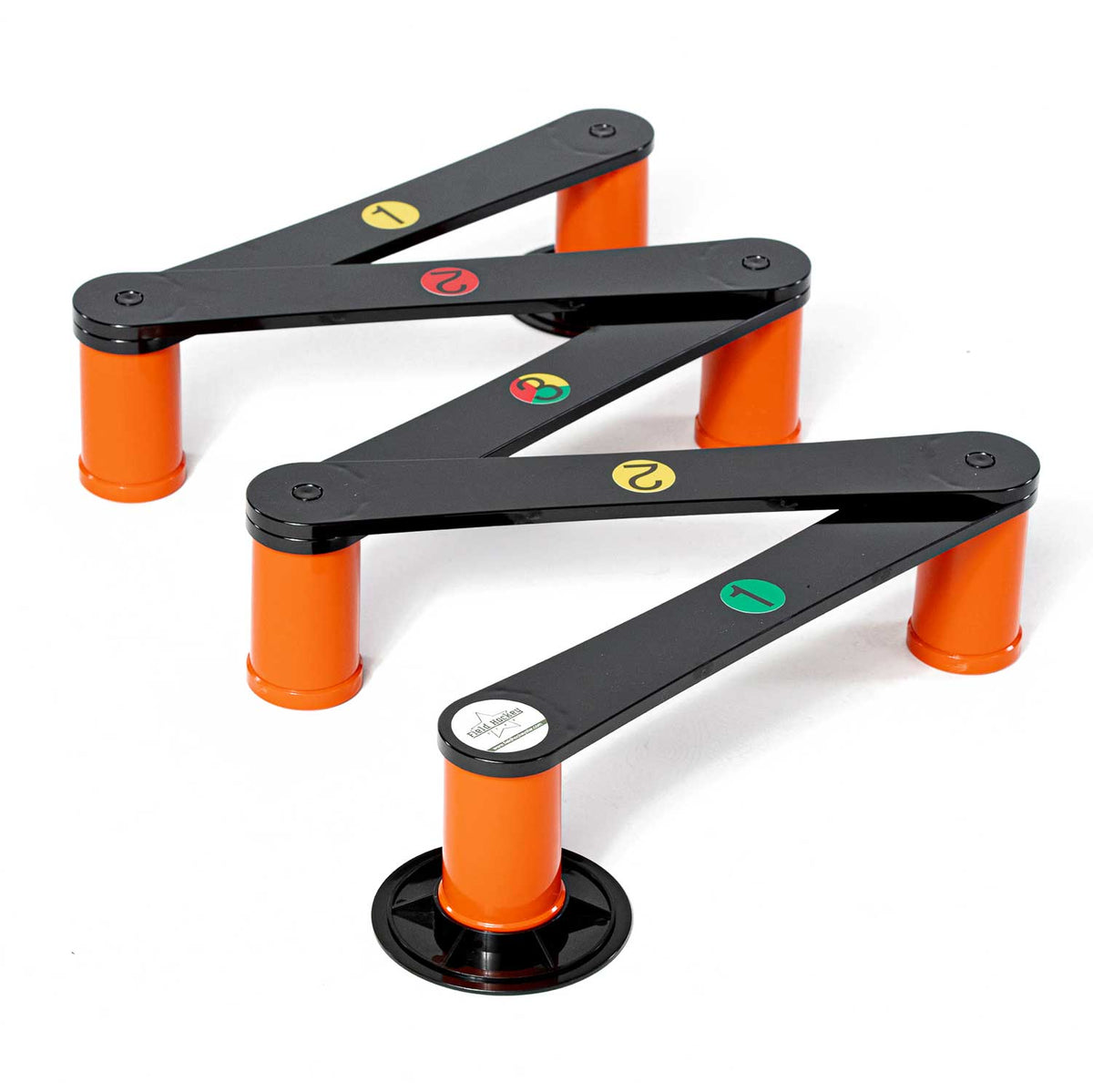
Set out four cones of different colours in a 3 × 3 m (10 × 10 ft) square. Dribble in the middle. A parent, coach or friend calls a colour; you dribble to that cone and back. Alone, you can use a Skiller with colour and number calls from the free Field Hockey App.
A 15-minute beginner session
| Time | Activity |
|---|---|
| 0–3 min | Warm-up: jog, side steps, easy ball taps |
| 3–6 min | Drill 1: open-side dribble |
| 6–9 min | Drill 2: Indian dribble on the spot |
| 9–12 min | Drill 3: cone slalom |
| 12–15 min | Drill 5: colour game, or time yourself through the slalom |
Swap Drill 4 in for Drill 1 on alternate days.
Common beginner mistakes
- Ball too close to the feet: you trip over it or can't move the stick freely. Push it further out.
- Gripping too tight with the right hand: the stick can't turn for the Indian dribble. Relax the right hand.
- Standing upright: less control and slower reactions. Bend the knees.
- Only using the forehand: defenders learn where you will go. Practise the reverse stick from day one.
- Always looking at the ball: you miss open teammates. Look up between touches.
Where and what you need
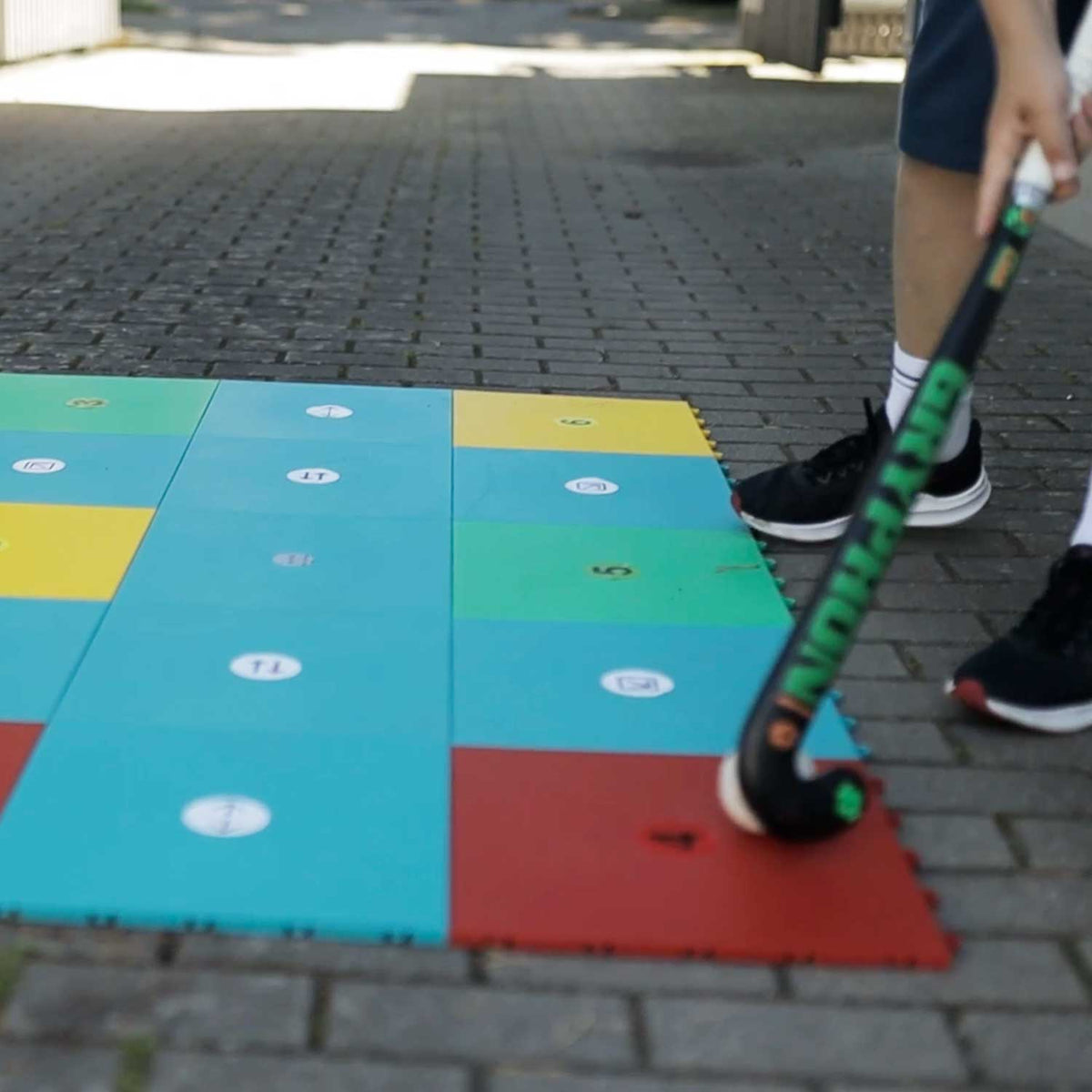
A stick, a ball and 4–6 cones. About 2 × 4 m (6.5 × 13 ft) of flat ground is enough for most of these drills: a garage, a driveway, short grass or a hall. If you want a dedicated home area, the Skills Zone gives you a tiled ball control surface. Honestly though, cones and a smooth floor are enough for beginners.
FAQ
What is the first dribbling skill to learn in field hockey?
The open-side (forehand) dribble with the correct grip. Once that is comfortable, learn the Indian dribble.
How long does it take to learn the Indian dribble?
Most beginners can do a slow version in a few sessions. Doing it fast, narrow and with the head up takes weeks of regular practice.
Can left-handed players dribble the same way?
Yes. Field hockey sticks are made for right-hand-side play, so all players use the same grip with the left hand at the top.
How often should a beginner practise dribbling?
10–15 minutes, 3–4 times a week, is a good start. Short and regular beats long and rare.
Can I practise dribbling indoors?
Yes. Dribbling keeps the ball on the ground, so it is safe in a garage, basement or hall with some clear space.
Related articles
- Indian dribble: step-by-step guide and drills
- How to do a pull-back (drag-back)
- How to improve ball control in field hockey
In the US? The Rebounder, Skiller and Skills Zone are also available on Amazon.