Quick answer
A good solo field hockey session takes 30 minutes and has five blocks: a 5-minute warm-up, 8 minutes of ball control, 8 minutes of passing and receiving, 5 minutes of footwork and a 4-minute test to finish. You need a stick, two or three balls, four cones and a flat area of about 3 × 4 m (10 × 13 ft). A wall or a rebounder gives you a passing partner. Do the session 2–4 times a week and keep the same structure, so you can measure progress.
Key takeaways
- Structure beats random practice. Use the same five blocks every time.
- Work in short sets of 45–60 seconds with 15–20 seconds rest to keep quality high.
- Train both sides: every forehand drill gets a reverse stick version.
- Finish with a test and write down the number.
- Indoors, keep the ball on the floor. Hits and lifted balls belong on the pitch.
What you need
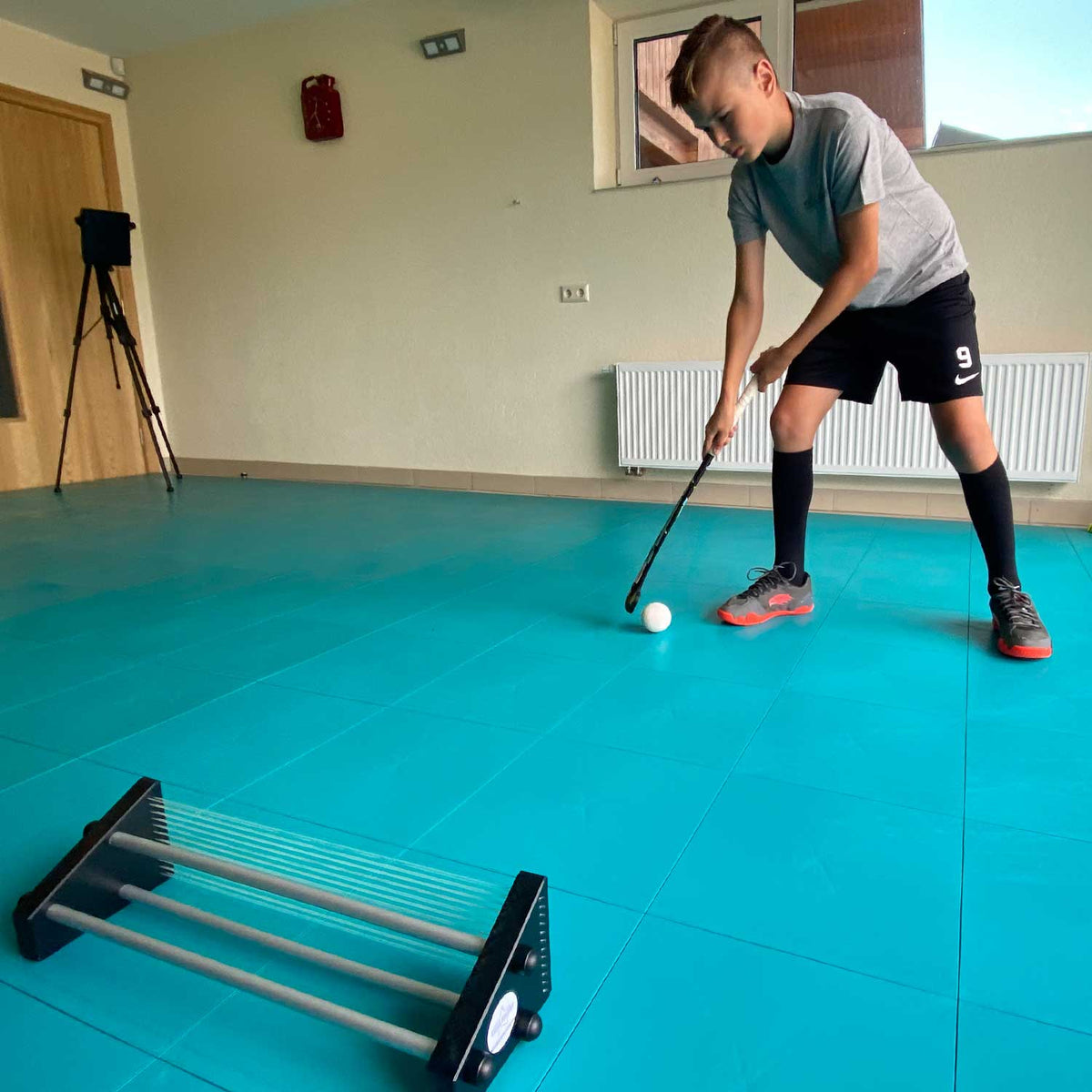
- Space: about 3 × 4 m (10 × 13 ft) of flat ground: a garage, a driveway, a back garden with short grass, or a quiet corner of a club pitch.
- Gear: stick, 2–3 balls, 4 cones or markers, a timer on your phone.
- A passing partner: a solid wall, or a Rebounder if there is no wall you can use.
- Optional: a Skiller or a few extra cones for ball control, and flooring tiles if your floor is rough or needs protecting.
The 30-minute session
| Block | Time | Goal |
|---|---|---|
| 1. Warm-up | 5 min | Raise heart rate, loosen hips and wrists |
| 2. Ball control | 8 min | Close control on both sides |
| 3. Passing and receiving | 8 min | Clean first touch, accurate push passes |
| 4. Footwork | 5 min | Quick feet with the ball |
| 5. Test | 4 min | Measure one skill and record it |
1. Warm-up (5 minutes)
- 1 minute easy jog or skipping on the spot.
- 1 minute lateral shuffles, low hips, 3 m (10 ft) each way.
- 10 walking lunges with a twist, 10 leg swings each side.
- 2 minutes easy ball touches: forehand taps, then reverse stick taps, then slow Indian dribble.
2. Ball control (8 minutes)
Place four cones in a line, 1 m (3 ft) apart. Work 45 seconds, rest 15 seconds.
- Set 1–2: Indian dribble on the spot. Wide first, then narrow and fast. Keep the ball in front of your feet.
- Set 3–4: Cone slalom. Weave through the cones with the Indian dribble, turn at the end and come back.
- Set 5–6: Pull-back and go. Dribble to the last cone, pull the ball back, turn and push away fast.
- Set 7–8: Head-up dribble. Look at a point on the wall and only glance down. If you use the Skiller with the free Field Hockey App, react to the colour or number calls instead.
3. Passing and receiving (8 minutes)
Stand 3–5 m (10–16 ft) from the wall or Rebounder. Work 60 seconds, rest 20 seconds.
- Set 1–2: Forehand push and receive. Stop the ball dead in front of your right foot, then pass again.
- Set 3–4: Reverse stick receive. Receive on the reverse stick on your left side, move it to the forehand, pass.
- Set 5–6: Receive and move. Receive, take one touch to the side, pass from the new spot. This builds the habit of receiving away from pressure.
4. Footwork (5 minutes)
Set the four cones in a 2 × 2 m (6.5 × 6.5 ft) square. Start in the middle with the ball. Dribble to a cone, touch it with the ball, come back to the middle, go to the next cone. Do 4 sets of 40 seconds with 30 seconds rest. Small steps, knees bent, ball close.
5. Test (4 minutes)
Pick one test and keep it for a month:
- Clean passes against the wall or Rebounder in 60 seconds, from 4 m (13 ft). A pass counts only if you control the return.
- Time for 3 laps of the cone slalom without losing the ball.
Do the test twice with a short break and write down the better score.
How to progress the plan
- Weeks 1–2: learn the drills at a speed where you rarely lose the ball.
- Weeks 3–4: same drills, faster, with fewer glances at the ball.
- Weeks 5–6: swap in harder versions: V-drags in the slalom, one-touch passing, receiving on the move.
If you only have 15 minutes, keep the warm-up and the test and pick one middle block. A short session done often is better than a long one done rarely.
Honest notes
- Solo practice builds technique and habits. It does not replace team practice, where you learn to read the game and play under pressure.
- A wall is free and works fine. A Rebounder helps indoors, on tiles, or when you can't use a wall.
- On the pitch you can add hitting and shooting with supervision. At home, stick to dribbling and push passes.
FAQ
How long should a solo field hockey practice be?
About 30 minutes is a good length for most players. It is long enough to cover the main skills and short enough to keep the quality high.
How often should I practise alone?
2–4 times a week works for most players, on top of team training. Leave at least one rest day a week.
What can I practise without a partner?
Dribbling, ball control, footwork, push passing and receiving against a wall or rebounder, and shooting at targets on a pitch.
Do I need a rebounder for solo practice?
No. A solid wall does the same basic job. A rebounder is useful when you have no wall you can use, or when you train indoors on tiles.
What should I do if I only have 15 minutes?
Warm up for 3 minutes, pick one skill block for 8–10 minutes, and finish with your test. Rotate the skill block each session.
Related articles
- Field hockey drills at home without a partner
- 15-minute field hockey workout before school
- 10 rebounder passing drills for solo training
In the US? The Rebounder, Skiller and Skills Zone are also available on Amazon.