
Quick answer
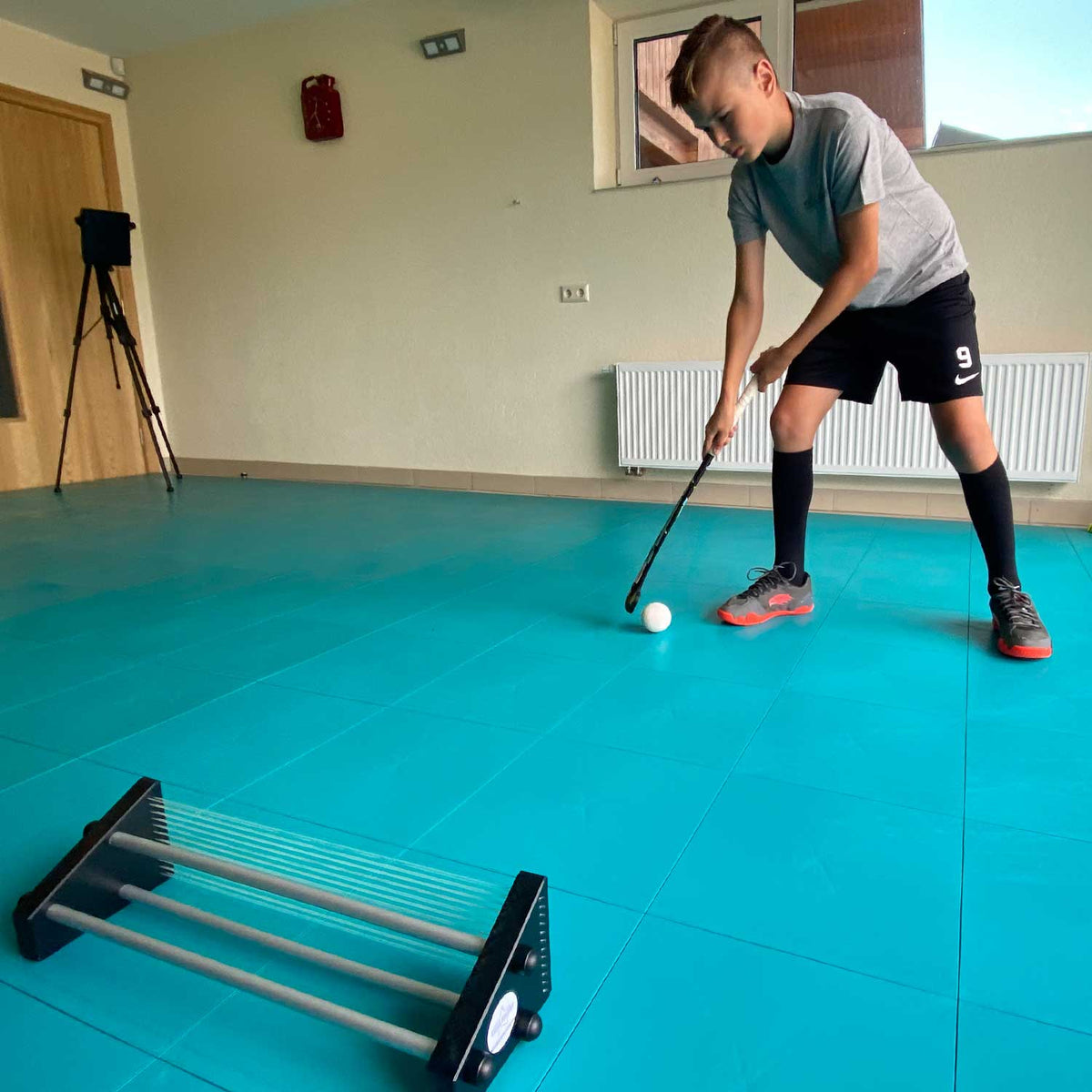
The best surface for home field hockey practice is flat, smooth and consistent, so the ball rolls true like it does on artificial turf. Smooth concrete is fast and free but hard on balls and sticks. Natural grass is soft and forgiving but bumpy and slow, so it suits fitness and big movements more than fine ball control. Training tiles give a smooth, even roll indoors or outside and protect the floor, but they are not real turf. For most players, the best setup is a smooth floor or tiles at home for ball control and passing, plus regular sessions on a real pitch.
Key takeaways
- Flat and consistent matters more than which material you use.
- Concrete is fast and free but wears balls and stick heads.
- Grass is safe and soft but bumpy, so close control is harder.
- Tiles give an even roll and protect floors, but they don't feel exactly like turf.
- Whatever your home surface, keep playing on a real pitch to adjust to it.
Surface comparison
| Surface | Ball roll | Pros | Cons | Best for |
|---|---|---|---|---|
| Smooth concrete (garage, driveway) | Fast, mostly true | Free, always available, dries fast | Wears balls and sticks, hard if you fall, cracks deflect the ball | Dribbling, push passes |
| Rough concrete or asphalt | Bumpy, unpredictable | Free | Ball jumps, heavy wear on gear | Fitness, simple dribbling |
| Natural grass | Slow, uneven | Soft, safe for movement | Ball bobbles, wet in winter, hard to do fine control | Footwork, fitness, longer passes on a lawn |
| Indoor hard floor (wood, vinyl) | Fast, very true | Smooth roll | Easy to mark or damage, slippery for shoes | Ball control, with floor protection |
| Training tiles | Even and consistent | Protect the floor, work indoors or outdoors, easy to lay | Cost, not the same feel as turf, cover a limited area | Ball control, passing, footwork at home |
| Artificial turf pitch | The real thing | Match conditions | Not at home, needs access | Everything, including hitting and shooting |
Concrete: fast and free
A smooth garage floor or driveway is where most home training starts. The ball moves quickly, which forces quick hands. Downsides: balls lose their surface faster, the toe and edge of the stick wear, and a crack or step sends the ball off line. Sweep the area first, and pick the smoothest patch you have. If you play on concrete a lot, keep one older ball for it.
Grass: soft but slow
Garden grass is fine for fitness, footwork and sprint work. For ball control it is a compromise: the ball bobbles and stops early, so your touches get bigger than they would on a pitch. Mow it short and pick the flattest part. Grass works for longer push passes to a partner or a wall at the end of the garden, as long as the ball stays on the ground.
Tiles: a consistent home surface
Training tiles click together into a flat area you can put down on concrete, a basement floor or outside. Flooring Tiles come as 18 tiles of 33 × 33 cm, which covers 2 m² (21.5 ft²), and work indoors and outdoors. That is enough for a ball control area. For passing, you need a lane: the Passing Kit combines a Rebounder with two sets of 18 tiles, 4 m² (43 ft²) in total.
If you want a marked area for footwork and reaction, the Skills Zone 360 is 25 tiles with symbols, 165 × 165 cm (65 × 65 in), used with the app.
Honest note: tiles are not artificial turf. The ball runs smoothly, but it doesn't feel exactly like a pitch, and tiles cover a small area. They are a home training surface, not a replacement for playing on turf.
Which surface for which skill?
- Close ball control and dribbling: smooth concrete, a protected indoor floor, or tiles.
- Push passing and receiving: a smooth lane of at least 4–5 m (13–16 ft) to a wall or Rebounder.
- Footwork and agility: grass or tiles, where falling hurts less.
- Hitting, slap hits and shooting: only on a pitch, with supervision and protective gear. Never at home.
How to set up any surface
- Measure the space. About 2 × 3 m (6.5 × 10 ft) is enough for ball control; add a lane of 4–5 m (13–16 ft) for passing.
- Clear breakables, cars and anything at ball height.
- Sweep away grit and small stones: they deflect the ball and damage it.
- Wear shoes with good grip for the surface.
- Keep the ball on the ground. No hitting or lifting at home.
FAQ
What is the best surface to practise field hockey at home?
A flat, smooth surface with a consistent roll: a smooth concrete floor, a protected indoor floor, or training tiles. Grass works for fitness and footwork.
Is concrete bad for field hockey sticks?
It wears the toe and edge faster than turf, and balls lose their surface. Many players keep an older stick and ball for concrete.
Can I practise on grass?
Yes, but the ball bobbles and slows down, so fine control is harder. Use grass for footwork, fitness and simple passing.
Are training tiles the same as artificial turf?
No. They give a smooth, even roll and protect your floor, but the feel is different and the area is small. Keep training on a pitch too.
How much tile area do I need?
About 2 m² (21.5 ft²) covers a ball control area. For passing to a rebounder, aim for a longer lane, such as 4 m² (43 ft²) of tiles.
Related articles
- Do you need special flooring for field hockey at home?
- Driveway field hockey drills
- How to build a home field hockey training area
In the US? The Rebounder, Skiller and Skills Zone are also available on Amazon.

