Quick answer
The best field hockey games for kids at home are short, simple and competitive: traffic lights dribbling, cone gates, a passing "bowling alley", beat-the-clock slaloms and copy-me challenges. Each game takes 3–5 minutes, needs only a stick, a ball and a few cones or household markers, and trains real skills like ball control, push passing and looking up. Keep the ball on the floor, never hit indoors, and stop while the child is still enjoying it.
Key takeaways
- Games beat drills for young kids. Turn every skill into a challenge, a race or a score.
- Keep sessions short: 15–20 minutes for under-10s, up to 30 minutes for older kids.
- Indoors, no hitting and no lifting the ball. Dribbling and gentle push passes only.
- Parents can play too. Kids love beating an adult at their own game.
- Change the games every week or two so they stay fresh.
Before you start
- Space: a hallway, garage or patio of about 2 × 4 m (6.5 × 13 ft) is enough for most games.
- Gear: a stick of the right size, a ball, 4–6 cones (plastic cups or shoes work too).
- Safety: move anything breakable, keep siblings and pets out of the swing zone, and agree one simple rule: the stick stays below the knee.
8 fun games
1. Traffic lights (ages 5+)
The child dribbles around the space. A parent calls colours: green means dribble fast, yellow means slow, red means stop the ball dead under the stick. Play 3 rounds of 1 minute. Add "purple" for a turn and "blue" for dribbling on the reverse stick.
Trains: ball control, listening while dribbling, quick stops.
2. Gate race (ages 6+)
Set up 5 "gates" (two cones about 50 cm / 20 in apart) around the room. The child dribbles through as many gates as possible in 60 seconds. They can't go through the same gate twice in a row. Write the score on a whiteboard and try to beat it.
Trains: close control, changing direction, looking up to find the next gate.
3. Bowling alley (ages 6+)
Stand 6 plastic cups or light cones in a triangle at the end of a hallway. From 3 m (10 ft), the child knocks them down with push passes. Count how many pushes it takes to clear them all.
Trains: push pass accuracy and weight of pass.
4. Copy me (ages 5+)
A parent or older sibling shows a move: a pull-back, a dribble round a cone, two taps from side to side. The child has to copy it. Then swap roles: the child invents a move and the adult copies. Kids love catching adults out.
Trains: new skills, creativity.
5. Beat the clock slalom (ages 7+)
Set 5 cones in a line, 1 m (3 ft) apart. Time one run there and back. Any touched cone adds 1 second. Three tries, best time counts.
Trains: dribbling speed with control.
6. Wall tennis (ages 8+)
Two players take turns pushing the ball against a wall or a Rebounder from about 3 m (10 ft). Each player must stop the ball before passing it back. A miss gives the other player a point. First to 7 wins.
Trains: receiving, push passing, concentration.
7. Colour chase with the Skiller (ages 6+)
If you have a Skiller, use the free Field Hockey App or call colours and numbers out loud. The child dribbles to the colour called as fast as possible. Without a Skiller, use coloured cones or paper plates.
Trains: head-up dribbling and reaction speed.
8. Hopscotch dribble (ages 7+)
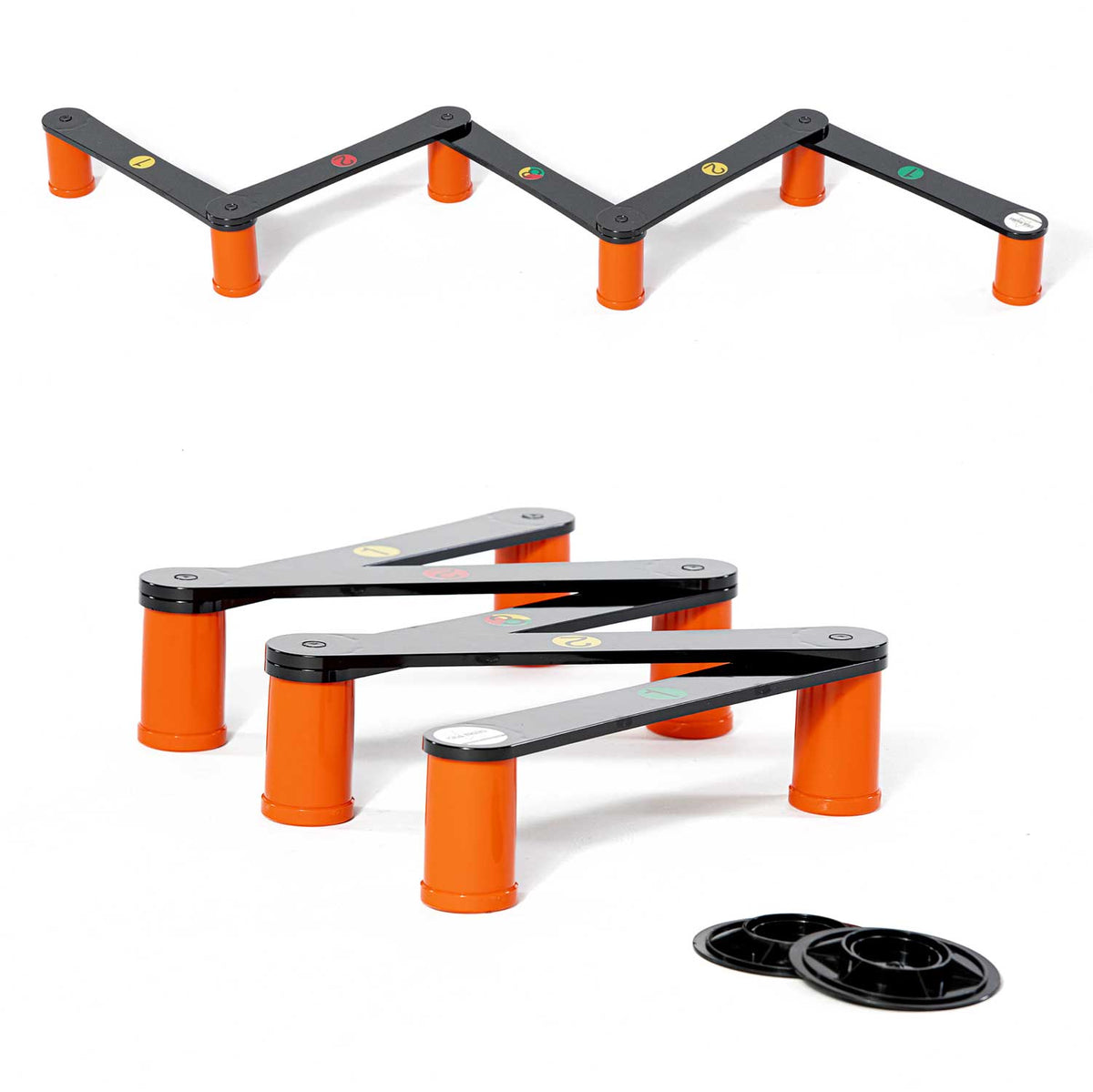
Kids step into squares on a pattern while keeping the ball close. You can tape squares on the floor, or use Skills Zone 360 tiles with symbols, where a parent or the app calls the next tile.
Trains: footwork, balance and ball control together.
A simple 20-minute game session
| Time | Game |
|---|---|
| 0–3 min | Traffic lights (warm-up) |
| 3–8 min | Gate race, 3 rounds |
| 8–13 min | Bowling alley |
| 13–18 min | Wall tennis or copy me |
| 18–20 min | Beat the clock: one final run to beat a record |
Tips for parents
- Praise effort, not just results: "great job keeping the ball close" is more useful than "you won".
- Let them win sometimes, but not always: kids notice when you are not trying.
- Keep a record board: personal bests on a whiteboard are very motivating.
- Stop early: end on a good moment so they want to play again tomorrow.
Honest note: none of these games need special equipment. Cups, shoes and a wall work fine. Training aids add variety and make it easier to play indoors, but they are a bonus, not a requirement.
FAQ
How long should kids practise field hockey at home?
About 15–20 minutes for under-10s and up to 30 minutes for older kids, a few times a week. Short and fun works better than long and forced.
Is it safe to play field hockey indoors?
Yes, if you keep the ball on the floor, never hit or lift it, keep the stick low and clear the space of anything breakable.
What age can kids start playing these games?
Simple games like traffic lights and copy me work from about age 5. Passing games work better from about 6–8.
Do we need a special ball for indoor games?
Not necessarily. A normal field hockey ball works on a smooth floor. Some families prefer a softer practice ball indoors to protect walls and furniture.
Can siblings who don't play join in?
Yes. Games like traffic lights, copy me and bowling alley work well with mixed ages and abilities.
Related articles
- Field hockey drills for kids (U8–U12)
- How to keep young field hockey players motivated to practise
- How to help your child get better at field hockey at home
In the US? The Rebounder, Skiller and Skills Zone are also available on Amazon.