
Quick answer
Reaction-time drills for field hockey train you to see a signal, decide and move the ball, all in a fraction of a second. The best drills combine a visual or audio cue (a colour, a number, a clap) with a ball action, such as a direction change or a pass. Train them in short bursts of 20–40 seconds with full rest, 2–3 times a week, because tired players react slowly. You can do most of them at home with a partner, cones of different colours, or an app that calls the cues. Keep the ball on the floor and focus on quick, clean movements.
Key takeaways
- In hockey, reaction means "see, decide, act" with the ball, not just fast feet.
- Use random cues. If you know what's coming, you're not training reaction.
- Short bursts and full rest: quality drops quickly when you're tired.
- Keep your head up so you can see the cue and the ball at the same time.
- Start slow and accurate; add speed only when the touches are clean.
Why reaction time matters in field hockey
A deflected pass, a defender's stick, a ball that bounces off a bump in the pitch: games are full of moments where you have very little time. Players who react well don't just move faster. They read the situation earlier and need fewer touches to deal with it.
You can't change your basic nerve speed much, but you can train how quickly you recognise a cue and pick the right action. That's what these drills do.
How to set up reaction training
- Space: 2 × 2 m (6.5 × 6.5 ft) for most drills, 3 × 3 m (10 × 10 ft) for movement drills.
- Cues: a partner calling colours or numbers, coloured cones, or the free Field Hockey App.
- Work and rest: 20–40 seconds of work, 40–60 seconds rest. 4–6 sets per drill.
- When: after a warm-up, near the start of a session, while you're fresh.
Drill 1: colour cone call
Place four cones of different colours in a 2 m (6.5 ft) square. Dribble in the middle. A partner calls a colour; you dribble to that cone, touch it with the ball and return to the middle.
- 4 × 30 seconds, 45 seconds rest.
- Progression: the partner calls two colours in a row, and you must go to both.
- Coaching point: keep the ball close during the turn at the cone.
Drill 2: clap and change
Dribble in a straight line, about 5 m (16 ft) long, at walking pace with Indian dribble. On a clap, change direction with a pull-back. On two claps, do a V-drag.
- 4 × 30 seconds per side, 45 seconds rest.
- Progression: increase dribbling speed.
Drill 3: number call on the Skiller
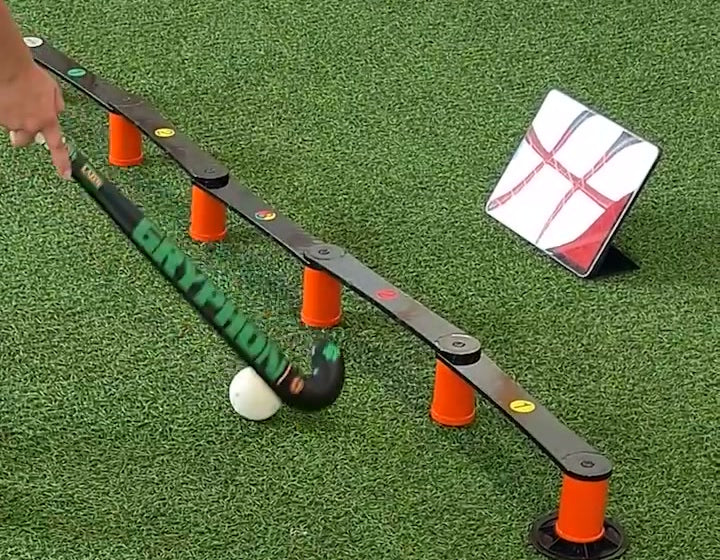
The Skiller has colours and numbers on it, and the free app can call them at random. Dribble around or through the Skiller and move the ball to the colour or number that is called.
- 5 × 30 seconds, 45 seconds rest.
- Start with a slow call rate. Speed it up only when you hit 9 out of 10 calls cleanly.
Honest note: a partner shouting colours at coloured cones works too. The Skiller and app are useful when you train alone or want random cues without a helper.
Drill 4: footwork on symbol tiles
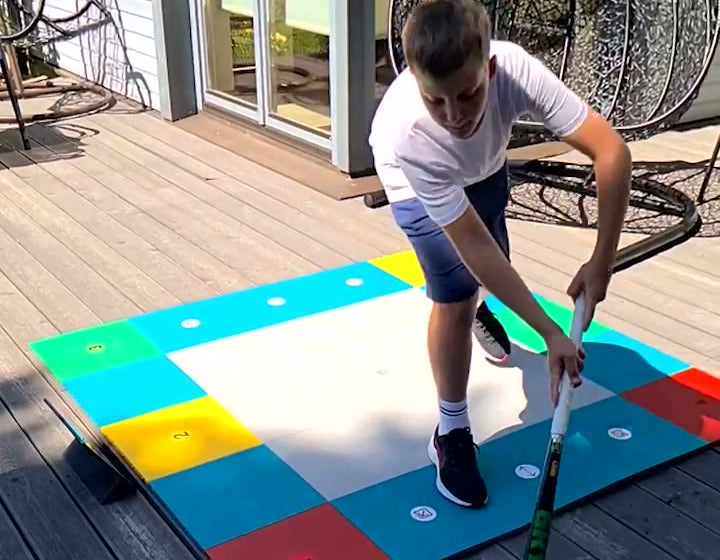
For whole-body reaction, use a tile grid. On the Skills Zone 360 (25 tiles with symbols, 165 × 165 cm / 65 × 65 in), the app calls a symbol and you step or dribble to it from the centre, in any direction.
- Without a ball first: 4 × 20 seconds, 40 seconds rest.
- Then with the ball: 4 × 30 seconds, 60 seconds rest.
No tiles? Use chalk marks or tape on the floor and a partner calling them.
Drill 5: rebound reaction
Stand 2–3 m (6.5–10 ft) from a wall or Rebounder. Push the ball at slightly different angles so the return is less predictable. Receive and control it on the forehand or reverse stick, depending on where it comes back.
- 4 × 40 seconds, 45 seconds rest.
- Progression: a partner stands behind you and calls "left" or "right" as the ball returns; you must move the ball to that side after receiving.
Drill 6: ball drop (partner)
This one trains pure reaction without a stick. A partner stands 1–2 m (3–6.5 ft) away and holds a tennis ball in each hand at shoulder height. They drop one; you catch it before the second bounce.
- 3 × 10 drops, 30 seconds rest.
- Good for younger players as a fun warm-up.
A 20-minute reaction session
| Block | Drill | Time |
|---|---|---|
| Warm-up | Jogging, lateral shuffles, easy touches, ball drop | 4 min |
| Block 1 | Colour cone call | 5 min |
| Block 2 | Clap and change | 5 min |
| Block 3 | Rebound reaction | 5 min |
| Finish | Easy dribbling, stretch | 1 min |
Do this 2–3 times a week. Change at least one drill every 3–4 weeks so the brain keeps being challenged.
Common mistakes
- Looking only at the ball: you miss the cue. Practise with your eyes up and the ball in your peripheral vision.
- Training when tired: reaction work at the end of a hard session teaches slow reactions.
- Predictable cues: if the partner always calls the same pattern, change it up.
- Sloppy touches: speed without control is not useful in a game.
FAQ
Can you improve reaction time in field hockey?
Yes. You can train how quickly you recognise cues and choose the right action with the ball. Regular, short reaction drills make that faster and more automatic.
How often should I do reaction drills?
Two to three times a week, for 10–20 minutes, early in a session while you're fresh.
Can I do reaction drills alone?
Yes. Use an app that calls random cues, or a wall or rebounder with varied angles. A partner makes many drills easier, but it's not required.
Are reaction drills good for kids?
Yes. Colour and number games are fun for younger players and build head-up habits early. Keep sets short and playful.
Related articles
In the US? The Rebounder, Skiller and Skills Zone are also available on Amazon.