
Quick answer
A good field hockey rebounder returns push passes along the ground at a consistent speed and angle, stays put when the ball hits it, and suits the surface and space where you will train. Before buying, check that it is made for a hard field hockey ball, how wide the return surface is, how stable it is, and whether it works on your floor, tiles or turf. Measure your space: you need about 3–6 m (10–20 ft) of passing distance. And be honest with yourself: if you have a solid wall you can use every day, you may not need a rebounder at all.
Key takeaways
- Buy for the ball you use: field hockey balls are small, hard and fast.
- Consistent return matters more than a strong return.
- Stability decides whether the rebounder is useful or annoying.
- Check your surface and space before you check the features.
- A free wall is a real alternative. A rebounder wins on flexibility, indoor use and angles.
Do you need a rebounder at all?
Start with the honest question. A rebounder makes sense if:
- you have no wall you can pass against (rented home, noise, damage, windows);
- you want to train indoors, on tiles or in a garage where the wall isn't suitable;
- you want to move your passing station around, for example on a turf pitch or in a team session;
- you want to practise receiving at different angles, which a flat wall can't easily give you.
If you have a smooth, solid wall and nobody minds the noise, use it. It is free and works well for push passes and receiving.
What to look for: the checklist
| Feature | Why it matters | What to check |
|---|---|---|
| Made for field hockey | A field hockey ball is hard and low. Rebounders built for larger or softer balls can return it too high or too unpredictably. | Product description names field hockey passing and receiving |
| Ground-level return | The ball should come back along the floor, like a real pass | Height of the rebound surface and how it meets the ground |
| Consistency | Repetition only works if the ball comes back predictably | Solid, even rebound surface without soft spots |
| Stability | A rebounder that slides or tips after every pass breaks the rhythm | Weight, base design, and whether it stays put on your surface |
| Width of the return area | A wider surface forgives slightly off-target passes, useful for beginners | Dimensions on the product page |
| Surface compatibility | Works on concrete, wood, tiles or turf? | Where the maker says it can be used |
| Durability | Hard balls hit it hundreds of times per session | Materials and build quality |
| Storage and transport | If it's hard to set up, you won't use it | Size, weight and how quickly you can move it |
Space and surface
For push passes and receiving you need about 3–6 m (10–20 ft) of passing distance and 2–3 m (6.5–10 ft) of width to move side to side. Beginners can start at 3 m and move back as the passes get firmer.
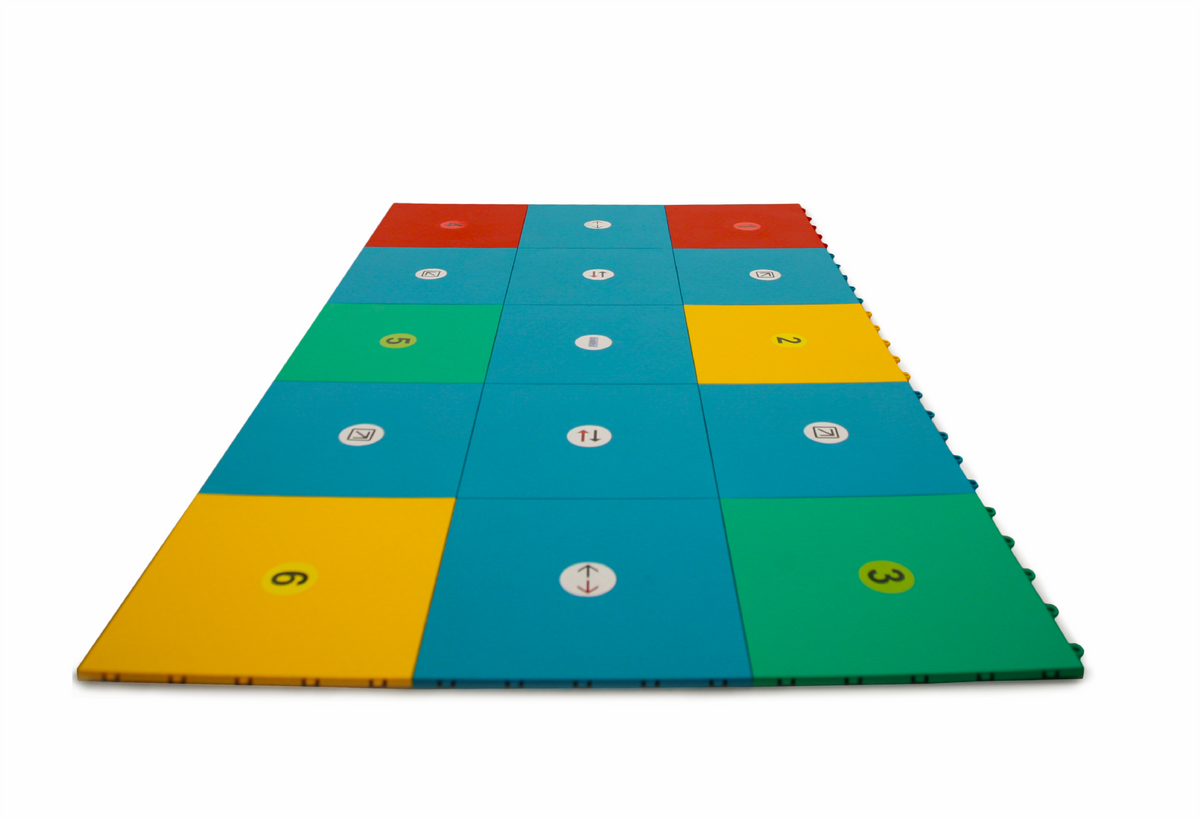
The surface matters as much as the rebounder. A smooth floor gives a true roll; rough concrete or uneven paving makes the ball bounce. If your floor is rough, slippery or needs protecting, flooring tiles create a consistent passing lane. One pack of 18 tiles covers 2 m² (21.5 ft²).
What a rebounder can and can't do
Good for
- Push passes and receiving on forehand and reverse stick
- One-touch passing and quick give-and-go patterns
- Receiving on the move and turning
- Hundreds of repetitions in a short session without a partner
Not a replacement for
- A real teammate: reading a pass, timing your run, communication
- Aerial passes, drag flicks and full-power hits, which belong on the pitch with a goal and supervision
- Game pressure from a defender
Check the maker's guidance before hitting hard at any rebounder. Most are built for passing, not for full-power shots.
Our option
The Field Hockey Star Rebounder is a patented rebounder designed for field hockey passing, receiving and one-timers. You can buy it on its own, or as part of a kit:
- Passing Kit: the Rebounder plus two packs of 18 flooring tiles, for 4 m² (43 ft²) of passing surface.
- Training Kit: the Rebounder plus a Skills Zone and a Skiller, for passing and ball control.
See the full rebounder collection for current options and dimensions.
How to get the most from a rebounder
- Train 15–20 minutes, 3–4 times a week, rather than one long session.
- Alternate forehand and reverse receptions.
- Count clean passes in 60 seconds and track the number weekly.
- Change distance and angle every few sessions to avoid autopilot.
FAQ
Is a rebounder better than a wall for field hockey?
Not always. A wall is free and fine for push passes. A rebounder is more flexible: you can use it indoors, on tiles or turf, and set it at different angles.
How much space do I need for a rebounder?
About 3–6 m (10–20 ft) of passing distance and 2–3 m (6.5–10 ft) of width. Beginners can start closer.
Can I hit hard at a field hockey rebounder?
Most rebounders are made for passing, not full-power hits. Check the maker's guidance, and keep hard hits for the pitch.
Can I use a rebounder indoors?
Yes, for push passes along the ground. Make sure the floor is protected and nothing breakable is nearby.
What age is a rebounder suitable for?
Any age that can push pass. Younger players start close with gentle passes; older players move back and add pace.
Related articles
- Best field hockey training equipment for home: honest guide
- How to receive the ball in field hockey
- Field hockey drills at home without a partner
In the US? The Rebounder, Skiller and Skills Zone are also available on Amazon.