
Quick answer
The simplest way to size a child's field hockey stick is to stand the stick upright next to them: the top should reach roughly the hip bone. Most kids' sticks run from about 26 to 36 inches (66–91 cm), and brands usually list length in inches. Use the chart below as a starting point, then check the hip test in person. If your child is between sizes, choose the shorter one for control. Young players also need a light stick with a low bow, not a heavy, aggressive adult model.
Key takeaways
- Hip-bone test: the top of the stick should reach about the top of the hip bone.
- Between sizes? Go shorter for better ball control.
- Light weight and a low or standard bow suit young players best.
- Kids grow fast. Expect to resize every one to two seasons.
- Charts are guides only; sizes differ slightly between brands.
How to measure
- Have your child stand upright in their usual sports shoes.
- Stand the stick vertically next to them, with the toe on the ground.
- Check where the top of the handle sits. Around the top of the hip bone is the usual target.
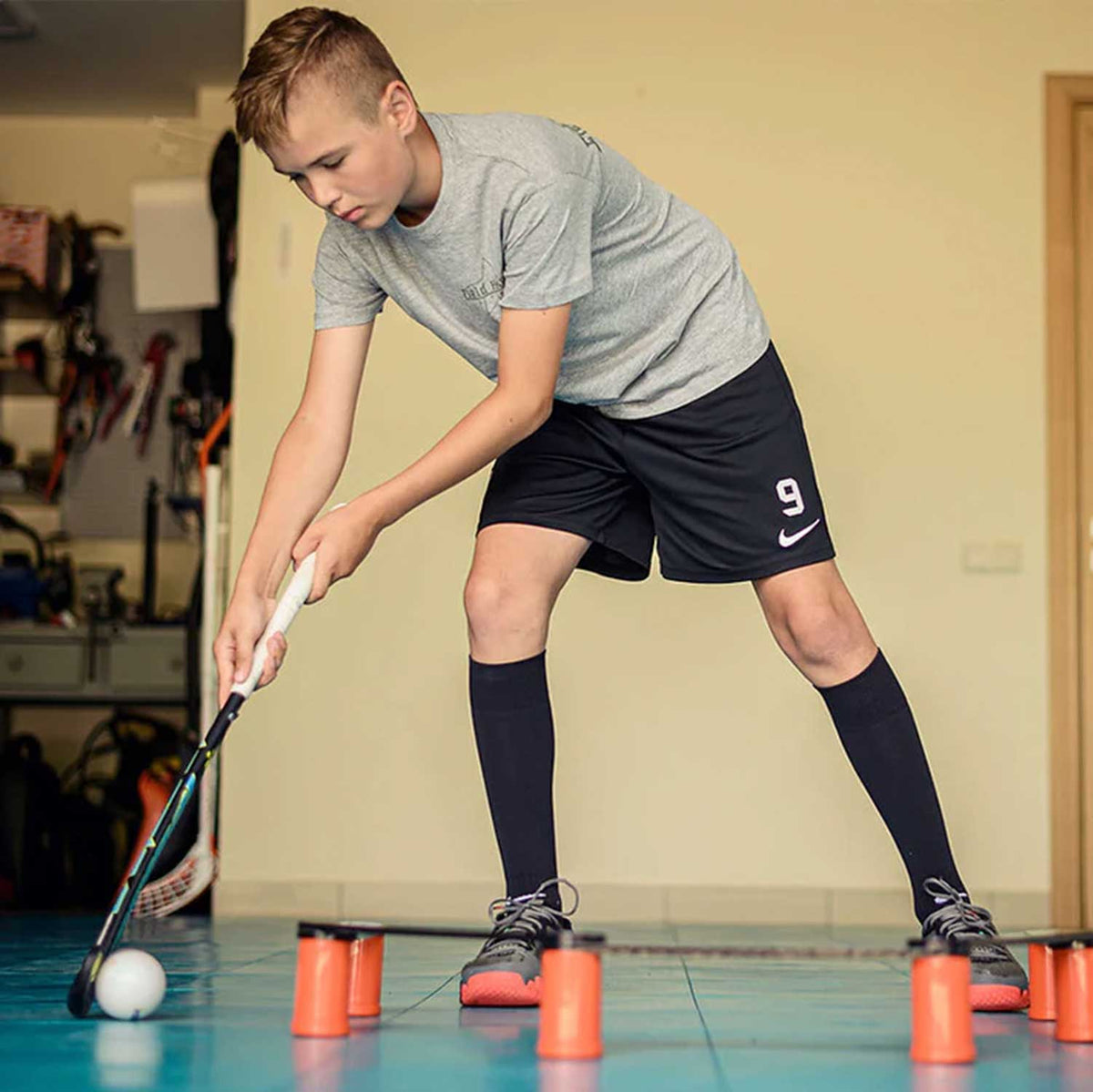
- Let them hold it in their playing position: knees bent, left hand at the top. They should be able to keep the stick flat to the ground without bending over too much.
Some coaches prefer a slightly shorter stick for young players because it keeps them low and makes ball control easier. Ask your child's coach if they have a preference.
Stick size chart for kids
These ranges are typical guidelines. Brands vary, so always check the specific size guide and do the hip test in person.
| Player height | Stick length | Typical age (very rough) |
|---|---|---|
| Under 104 cm (3 ft 5 in) | 26 in (66 cm) | 4–5 |
| 104–112 cm (3 ft 5 in – 3 ft 8 in) | 28 in (71 cm) | 5–6 |
| 112–122 cm (3 ft 8 in – 4 ft) | 30 in (76 cm) | 6–8 |
| 122–132 cm (4 ft – 4 ft 4 in) | 32 in (81 cm) | 7–9 |
| 132–142 cm (4 ft 4 in – 4 ft 8 in) | 34 in (86 cm) | 9–11 |
| 142–155 cm (4 ft 8 in – 5 ft 1 in) | 35 in (89 cm) | 10–13 |
| 155–165 cm (5 ft 1 in – 5 ft 5 in) | 36 in (91 cm) | 12–15 |
| 165–178 cm (5 ft 5 in – 5 ft 10 in) | 36.5–37.5 in (93–95 cm) | Teens and adults |
Age is only a rough hint. Always size by height and the hip test, not by age.
Signs the stick is the wrong size
| Too long | Too short |
|---|---|
| Player stands too upright when dribbling | Player bends over a lot and strains the back |
| Ball runs too far from the body | Reach on tackles and receiving feels limited |
| Reverse stick touches feel clumsy | Handle sits well below the hip bone |
| Stick toe digs into the ground | Player has clearly grown since last season |
Other things to check (besides length)
Weight
For young players, lighter is better. A heavy stick makes control slow and can strain wrists. Junior sticks are usually much lighter than adult sticks.
Bow
The bow is the curve along the stick. Kids should use a low or standard (regular) bow. Extreme low bows are designed for advanced 3D skills and drag flicks, and they make basic hitting and receiving harder to learn. Rules limit how big the bow can be, but junior sticks are well within those limits.
Material
Wooden sticks are common for beginners. They are forgiving and absorb vibration. Composite sticks with some fibreglass or carbon become useful as players get older and stronger. A high-carbon stick is stiff and powerful, which is rarely needed for a young child.
Toe shape
Most kids' sticks have a standard or "midi" toe, which is a good all-round choice. Shorter toes help quick moves; bigger toes give a larger receiving area. For beginners, a standard toe is fine.
Practical buying tips
- Try before you buy if you can. Do the hip test in the shop or at the club.
- Don't size up "to grow into". A stick that is too long slows skill development. Buy for now.
- Ask the club. Many clubs have spare or second-hand junior sticks for beginners.
- Left-handed kids use the same right-handed sticks as everyone else. There are no left-handed field hockey sticks in normal play.
- Grip: a fresh grip or overgrip makes an older stick feel much better.
Safety
Kids should wear shin guards and a mouthguard in every training session and game. Many leagues also require or recommend eye protection for young players, especially in the US. Check your league's rules.
FAQ
What size field hockey stick does my child need?
Stand the stick upright next to your child. The top should reach about their hip bone. For most kids, that means somewhere between 26 and 36 inches.
Should I buy a bigger stick so my child can grow into it?
No. A stick that is too long makes ball control harder. Buy the right size now and expect to replace it every one to two seasons.
Are field hockey sticks measured in inches or centimetres?
Most brands list stick length in inches, both in Europe and the US. Our chart gives centimetres too.
Is there a left-handed field hockey stick?
No. All players, including left-handers, use the same stick and play with the flat side on their right.
What bow should a child's stick have?
A low or standard bow. Extreme low bows are made for advanced skills and are not helpful for beginners.