Quick answer
You don't need a ball control trainer to get better at dribbling. Cones, a ball and a plan are enough to learn the Indian dribble, pull-backs and V-drags. A trainer like the Skiller earns its place when you train alone a lot and want two things cones don't give you: a fixed, compact setup that keeps the ball in a tight area, and colour and number cues for head-up and reaction work through an app. If you are a beginner on a small budget, start with cones. If you already train at home 3–4 times a week and get bored, a trainer adds variety and decision-making.
Key takeaways
- Cones are cheap, flexible and enough for most dribbling drills.
- The Skiller's main extra is reaction work: colour and number cues you respond to with your eyes up.
- A compact trainer suits small indoor spaces where cones keep getting knocked over.
- Neither tool replaces practice against real defenders.
- Buy for the problem you have, not for the tool.
What each option does well
| Cones | Skiller | |
|---|---|---|
| Cost | Very low | Entry-level training aid |
| Setup | Any shape, any size, needs resetting when knocked | Fixed and compact, quick to put down |
| Space needed | From a small square to a whole pitch | Small, suits a garage or hallway |
| Head-up and reaction | Only with a partner calling | Colours and numbers, with cues from the free app |
| Game-like movement | Better: you can set long slaloms and gates | Limited to close control in a tight area |
| Team use | Easy to share across a whole squad | One player at a time, works well as a station |
When cones are enough
- You are learning the basics: grip, ready position, open-side dribble, Indian dribble.
- You have space outside for slaloms, gates and longer dribbles.
- Someone at home can call directions or colours for you.
- You coach a team and need equipment for 12 players at once.
Six to ten flat cones cover almost every beginner and intermediate dribbling drill.
When a ball control trainer helps
- You train alone most of the time and want reaction work without a partner.
- Your space is small, and cones get kicked around or slide on a smooth floor.
- You struggle to dribble with your head up, and need something to force your eyes off the ball.
- You want to track scores in an app to stay motivated.
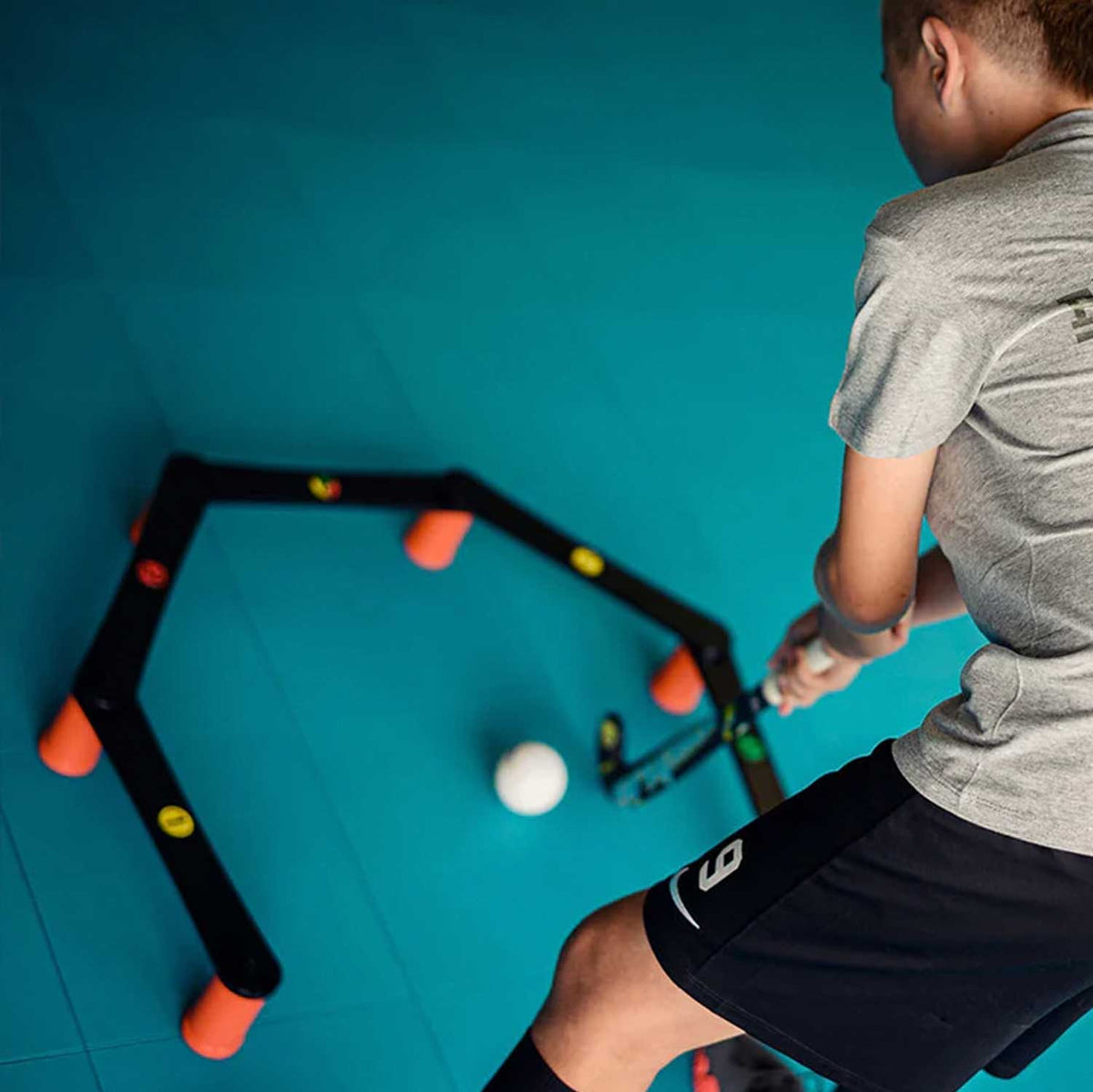
The Skiller is a compact ball control and reaction tool marked with colours and numbers. Used with the free Field Hockey App, it calls out targets you respond to, which is hard to copy with cones when you train alone.
Honest limits of the Skiller
- It trains close control in a tight area. It does not train dribbling at speed over distance.
- It does not replace beating a real defender, who moves and reacts.
- It needs a flat, smooth surface to work well, like a garage floor or tiles.
- Indoors, keep it to ground skills. No hitting or lifting.
Three drills to try with either tool
1. Tight Indian dribble (3 × 45 seconds)
Cones: two cones 60 cm (2 ft) apart; dribble from side to side between them without touching. Skiller: Indian dribble within the trainer's area. Focus on soft hands and quick, small touches.
2. Colour call (4 × 30 seconds)
Cones: four cones of different colours in a 2 m (6.5 ft) square; a partner calls a colour and you dribble to it and back to the centre. Skiller: the app calls the colour or number and you move the ball to it. Keep your eyes up and only glance down.
3. Pull-back and go (3 × 45 seconds)
Dribble into the cones or trainer, pull the ball back, then accelerate away 3 m (10 ft). Turn and repeat on the other side.
Other options to consider
- A wall: free and great for passing and receiving, which cones and the Skiller don't cover.
- Skills Zone: a training area of connectable tiles for ball control, with a bigger area to work in.
- Training Kit: Rebounder, Skills Zone and Skiller together, if you want to cover ball control and passing at home.
My recommendation
Start with cones and a clear plan. After a month, look at what is holding you back. If it is head-up dribbling and reactions, and you train alone, the Skiller is a good next step. If it is passing and receiving, a wall or a rebounder will help more than any ball control trainer.
FAQ
Is the Skiller worth it for a beginner?
It can be, but cones are enough to learn the basics. The Skiller adds more value once you train alone regularly and want reaction work.
Can I use cones for head-up dribbling?
Yes, if someone calls colours or directions for you. Alone, it is harder to force yourself to look up, which is where an app-based trainer helps.
How much space does a ball control trainer need?
Less than a cone course. A small flat area in a garage, hallway or on tiles is usually enough for close-control drills.
Can the whole team use one Skiller?
Yes, as one station in a rotation. For whole-group drills, cones are more practical.
Will a ball control trainer make me a better dribbler on its own?
No tool does that. Regular, focused practice does. A trainer makes that practice easier to do at home and more varied.
Related articles
- Best field hockey training equipment for home
- Skills Zone vs Skills Zone 360: which one fits you
- Head-up dribbling: drills to stop looking at the ball
In the US? The Rebounder, Skiller and Skills Zone are also available on Amazon.